
Future Texas
Expand the cosmic scale a tad.
I am increasingly convinced the book I'm writing on Texas futures-thinking needs to exist. I have not found the story told anywhere: Harris County Sheriff's Department providing a group of Vietnam-era Huey helicopters to a 1999 spectacle production of orchestral music and a multi-story illuminated future cone conceived by a futurist architect, to be interpreted in 2099, and sponsored by Microsoft no less. Or the tangential connection to the crash of a Robinson R22B helicopter at Mercer and W. Alabama that killed two people weeks before the scheduled event.
When I wrote about Houston's helicopter boom in my Kohoutek essay, that detail felt superfluous. I nearly cut it. Now I'm glad I didn't.
My research continues to surprise me. I'm happy. I'm writing the book now.
October 9, 2025—
I've been thinking of a new theme focus. Something more dynamic, more inspired, a tribute to creativity, a fanfare to the spirit of creation. You know, expand the cosmic scale a tad. Trumpets and choppers are only the instruments, the medium... not the message. —Doug Michels
More notes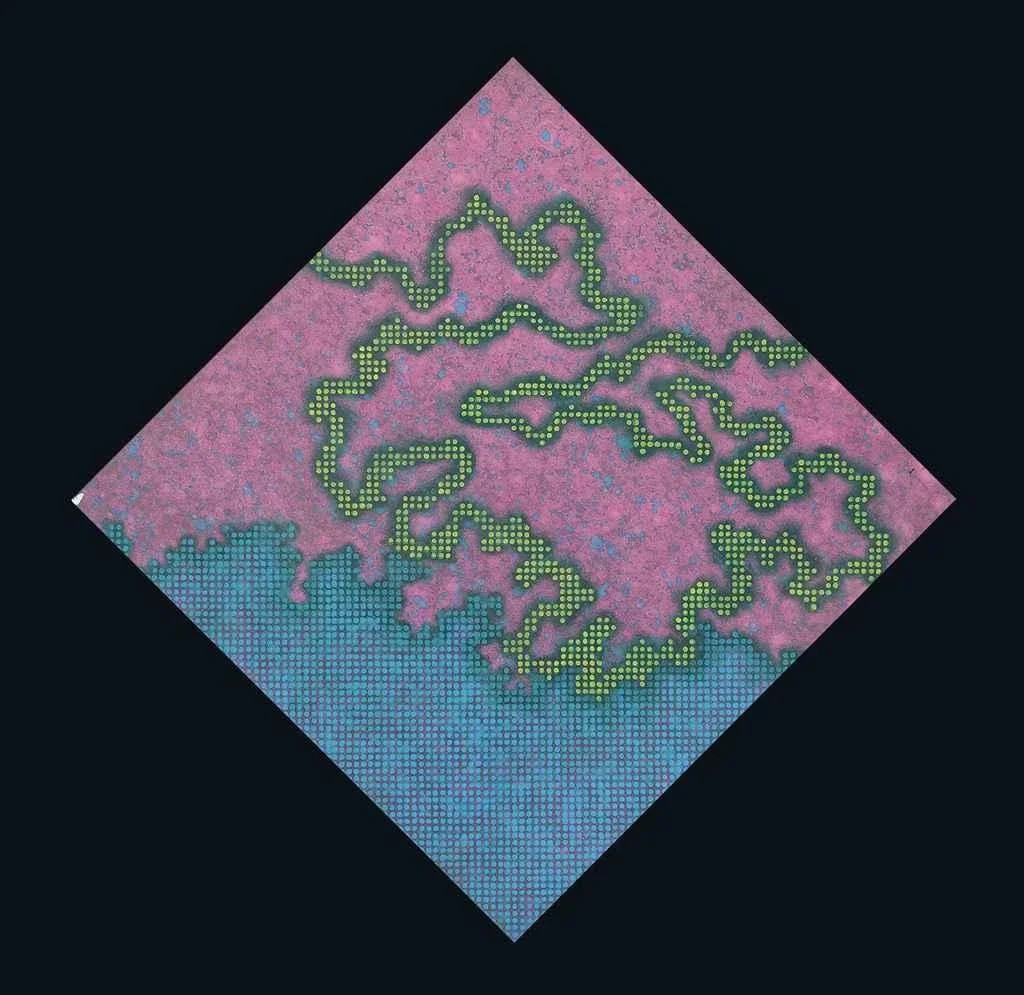
A Sharp Blade of Progress
Animal futures and the city of the future: a place with space for people.

Image: City of Edmonton Archives
In 1965, Edmonton's Metropolitan Edmonton Transportation Study (METS) proposed a six-lane freeway through MacKinnon Ravine. The METS plan would have destroyed a big chunk of pristine, forested river valley. Episode 58 of the podcast Let's Find Out - The MacKinnon Ravine Mystery tells the story of women who challenged this vision of progress.
The most delightful thing, to me, that the researchers found buried in the archives was a doodle.
Woodland creatures discussing what had happened to them as a result of the proposed freeway through their home. One of the women had drawn animals trying to make sense of their future. Bears and squirrels and birds working through the logistics of survival in a concrete ravine. I can't think of a more serious and silly piece of impromptu speculative futures work!
My grandmother, Marie, appears in a 1965 Edmonton Journal photograph from this story, holding a protest sign with other women who had just walked down onto the freeway roadbed to stop the machines. Her group was the Save Our Parks Association, and her voice cuts through the archives with remarkable clarity. "They (the city) are out of their minds doing this," she said. "It's the old colonial spirit, just exploit for material convenience with no regard for what comes afterward."
Their group understood that true progress might mean choosing not to build. They had even contacted Robert Moses, the legendary master builder who had transformed New York with bridges and highways, not to ask how to build, but how to stop building. Even Moses might have wisdom about what not to do.
My grandmother had studied philosophy and philology at Jagiellonian University. My grandfather was an engineer and forester who had run Tatra National Park. Another woman in the group, Margaret Chappelle, was an accomplished artist who served as president of the Federation of Canadian Artists, with work displayed at the Smithsonian Institution. Yet the press consistently diminished them as housewives whose environmental concerns were somehow less legitimate than engineers' traffic calculations.
"Our city fathers think this ravine is a dump. It is not. The city of the future will be a place with space for people. Has the city no foresight? Our future generations will need parklands more than we do," my grandmother is quoted as saying. The dismissive coverage missed what these women were doing. They possessed expertise, but more importantly, they were asking questions about what we were building towards.
It took eighteen years, but they won. In December 1983, city council dismissed the river valley policy that allowed major roadways through the valley. Progress, it turned out, sometimes cuts in the opposite direction from what planners expect.


Speculations that included human-invented animal voices offered ideas that were different from way the technical studies, focused purely on traffic flow.
The worried woodland creatures sketch points toward systematic approaches researchers are developing today. The US Forest Service has published work on Multispecies Storytelling in Forests of Dense Settlement that explores how different species might experience and respond to environmental change. I am not affiliated with this research, but it examines how storytelling can help us understand landscapes from multiple perspectives simultaneously, much like those Edmonton protesters imagining animal conversations about freeway construction.
Houston Foresight has explored interspecies communication futures through research on AI-enabled animal communication. The More-than-Human Futures Research Group at Queensland University of Technology develops multispecies speculative design approaches. The RSPCA's Animal Futures Project created five scenarios examining different futures for animals to 2050.
Other resources include the Interspecies Future Initiative through LAS Art Foundation exploring new rights for nonhuman life, and the Multispecies Lab at The New School imagining different ways for more-than-human life. (My other essay Kohoutek touches on dolphin and human futures, leading to bigger and weirder questions about whose voices are included when we try to design tomorrow.)
Worldview shapes how we imagine tomorrow. The engineers saw traffic problems requiring highway solutions. The women saw living systems requiring protection, generating entirely different preferred futures. Building from this notion of worldview, the question becomes one of legitimacy: who do we see as legitimately able to imagine consequences and advocate for alternatives, and whose voice do we feel we can legitimately exclude? Interestingly, the podcast touches on the hangover of the McCarthy era and self-censorship, or self-exclusion for protection, which adds another dimension.
The drawing of woodland creatures asking questions is more sophisticated than it seems. Picture people gathered around a table, sketching conversations between animals about a highway that didn't yet exist. They were running scenarios. Alternative futures are inevitably going to be shaped by who gets to participate in the conversation. The exercise was simple but also strategic: applied foresight both radical and practical.
October 5, 2025—

References
Binlot, Ann. 'The Woman Who Saved Old New York', BBC Culture, 9 May 2017, https://www.bbc.com/culture/article/20170509-the-woman-who-saved-old-new-york, accessed 26 September 2025.
Chappelle, Margaret. 'Margaret Chappelle: The Artist Who Saved the MacKinnon Ravine', City Museum Edmonton, 2 November 2021, https://citymuseumedmonton.ca/2021/11/02/margaret-chappelle-the-artist-who-saved-the-mackinnon-ravine/, accessed 26 September 2025.
Front Image
Harold Cohen - Landscape Remembered. 1966
More notes
Options for Tomorrow’s City
A process exhibition and futures maze mounted over the winter of 1972/1973 at Dallas Museum of Fine Art.
Image: Lidji Design
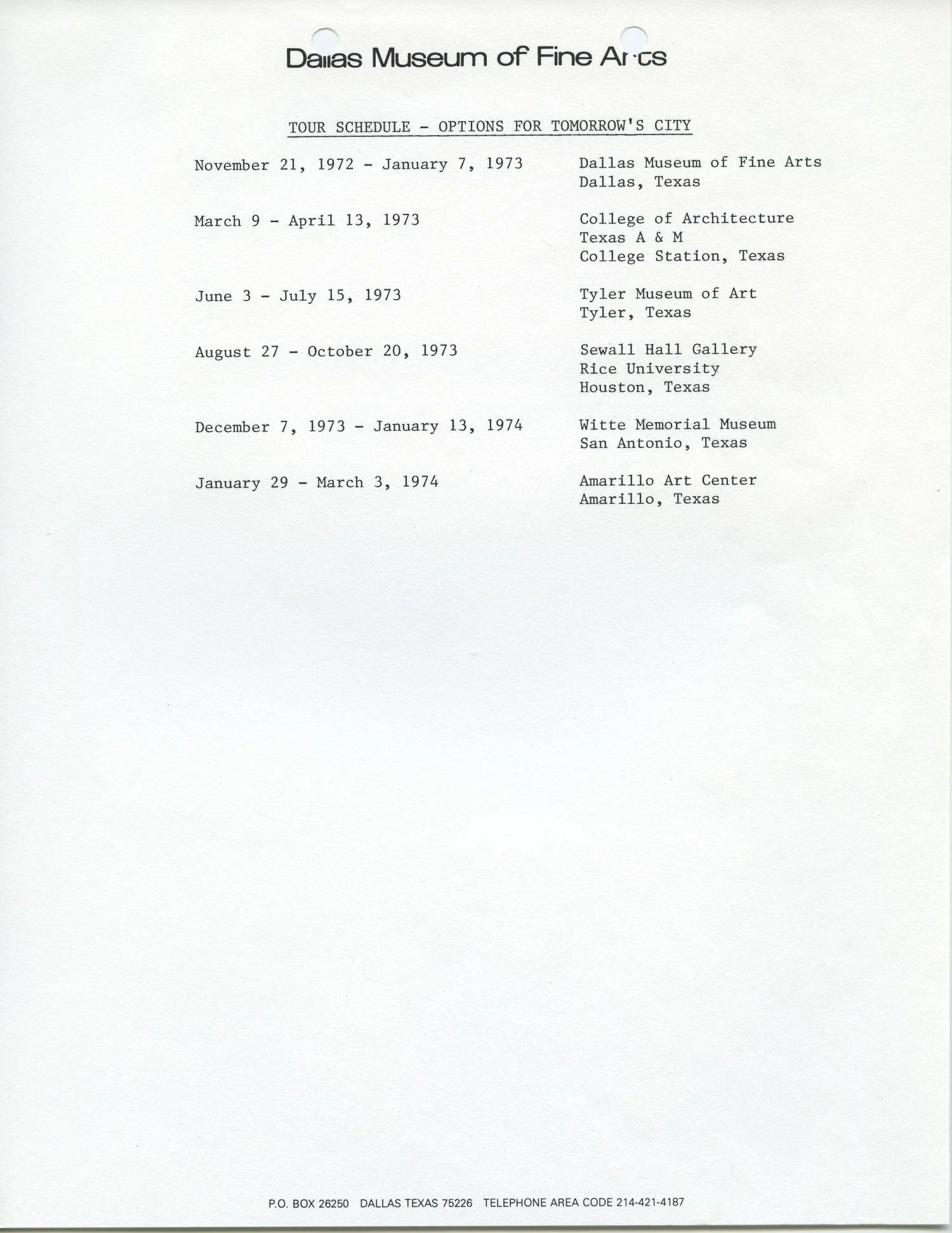
Image: DMA
Options for Tomorrow's City was a process exhibition mounted over the winter of 1972/1973 at Dallas Museum of Fine Arts, in partnership with the Department of Planning and Urban Development of the City of Dallas.
A guide would take visitors through a maze, starting with the past, of course, to see how problems had evolved. Next they'd walk through today's Dallas (the Dallas of 1972), but experiencing it in a manner "very different from your everyday contact", according to the press release.
Getting deeper into the maze, a visitor was prompted to decide what kind of city they'd like to live in tomorrow, keeping a record of their solutions by placing stamps in designated sheets provided to exhibition visitors. The idea was the sheet would then become a picture window illustrating the kind of city you had designed, one that you could take home with you.
The final segment of the experience was to explore many different kinds of tomorrows and future environments, utilizing six big screen audiovisual displays, called "The Talking Stamp Map".
Without being able to see the video work, Options for Tomorrow's City appears to be relatively standard public engagement and planning research, with additive cultural authority in the museum space. Guides were members of the Department of Planning and Urban Development. Visitors were asked questions such as "Do you want more deserted inner city streets or more pedestrian malls?" and "Would you let water pollution be continued or stopped?" The bias built into such questions is obvious. Who advocates for pollution? This straightforward approach to foresight planning reveals something about how institutions believed citizens should engage with urban futures.
What I like about this moment is the backdrop: those in Dallas with the means and connections had the bright idea to link the museum with the planning department. This suggests a cohesion and functional exchange between cultural leaders and city governance that feels necessary from a purely progressive (in the sense of making progress) perspective. The collaboration implied a shared belief that futures-thinking could belong in public space, that citizens could meaningfully participate in designing tomorrow's city through guided interaction. (A more cynical interpretation might be that the design was a gimmick, a means to an end).
The whole effort becomes a little richer when considering what else was happening in the space. Alongside this civic exercise in democratic “museum futurology” was an exhibition celebrating Expositions of the 1930s. That earlier Dallas fair had imagined futures through monumental architecture drawing from archaic Greek, Mayan, and Aztec forms, blending technological optimism wrapped in ancient aesthetic authority.
This created a funky, and very 1970s, layering of eras and anticipation. There was also work very much of its moment being shown: artist Robert Graham was creating miniature worlds using small human figures positioned within plexiglass boxes and domes. His approach to scale created intimate universes where viewers peered down at tiny scenarios.
These contained environments, almost like mini pavilions, suggested more ambiguous relationships with futurity than the stamp-collecting literalism of the planning department. Where the civic exhibition promised agency through participation, Graham's sealed worlds questioned whether the future might be something we observe and who’s in control. The term “worldbuilding” comes to mind.
The retrospective celebrated past visions of the future wrapped in timeless architectural forms. Graham's figures, in transparent containers, suggested something more uncertain about human agency within the systems we construct to contain possibility. The civic exhibition assumed citizens can vote their way to better tomorrows through guided choice-making.
All three approaches had emerged from the same cultural moment, yet pointed toward entirely different relationships with time and change. Perhaps the simultaneous approaches to tomorrow is itself the most accurate representation of how alternative futures work: not as singular destinations but as complementary invitations.
September 24, 2025
—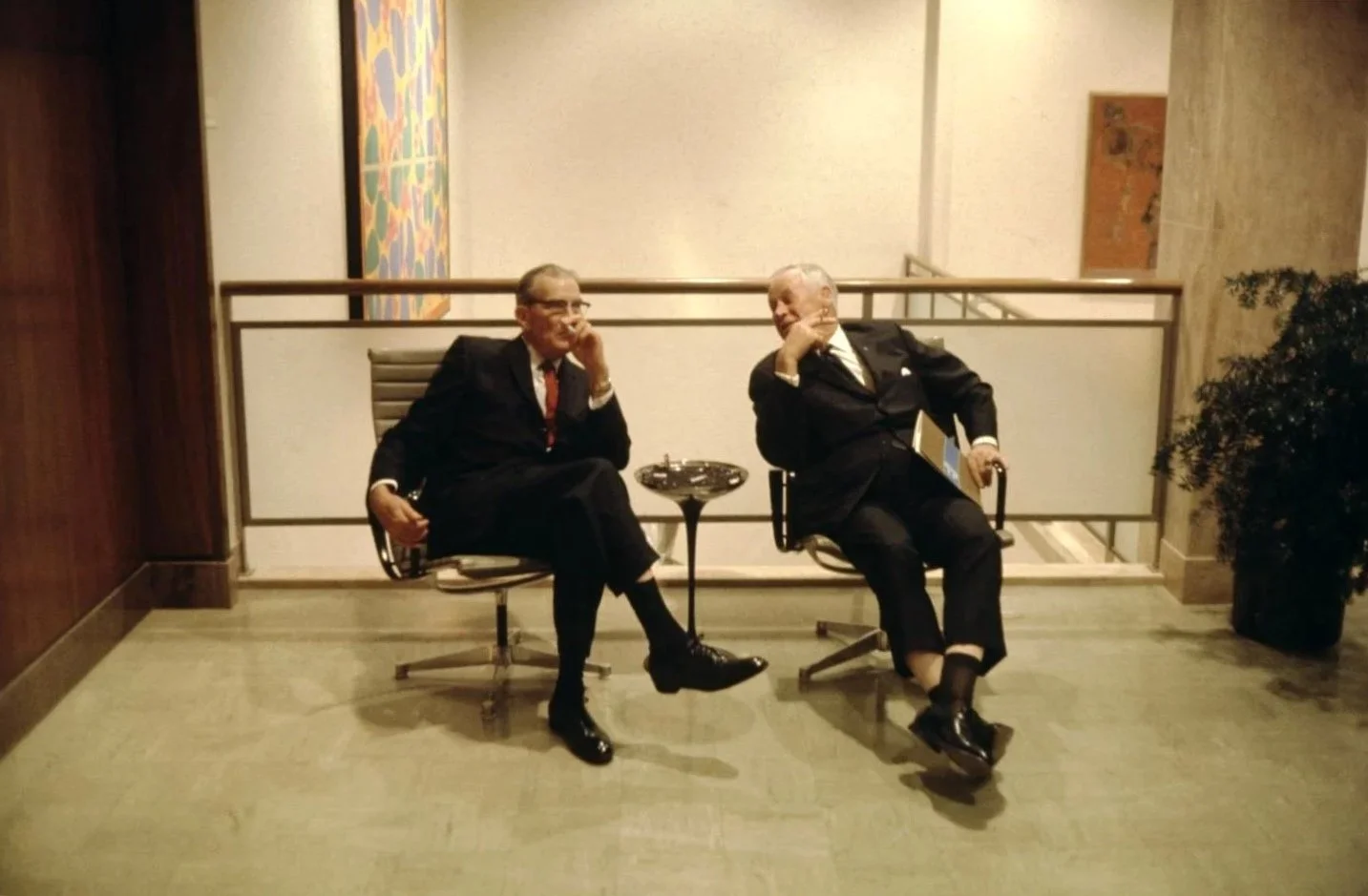
Image: DMA. 1972
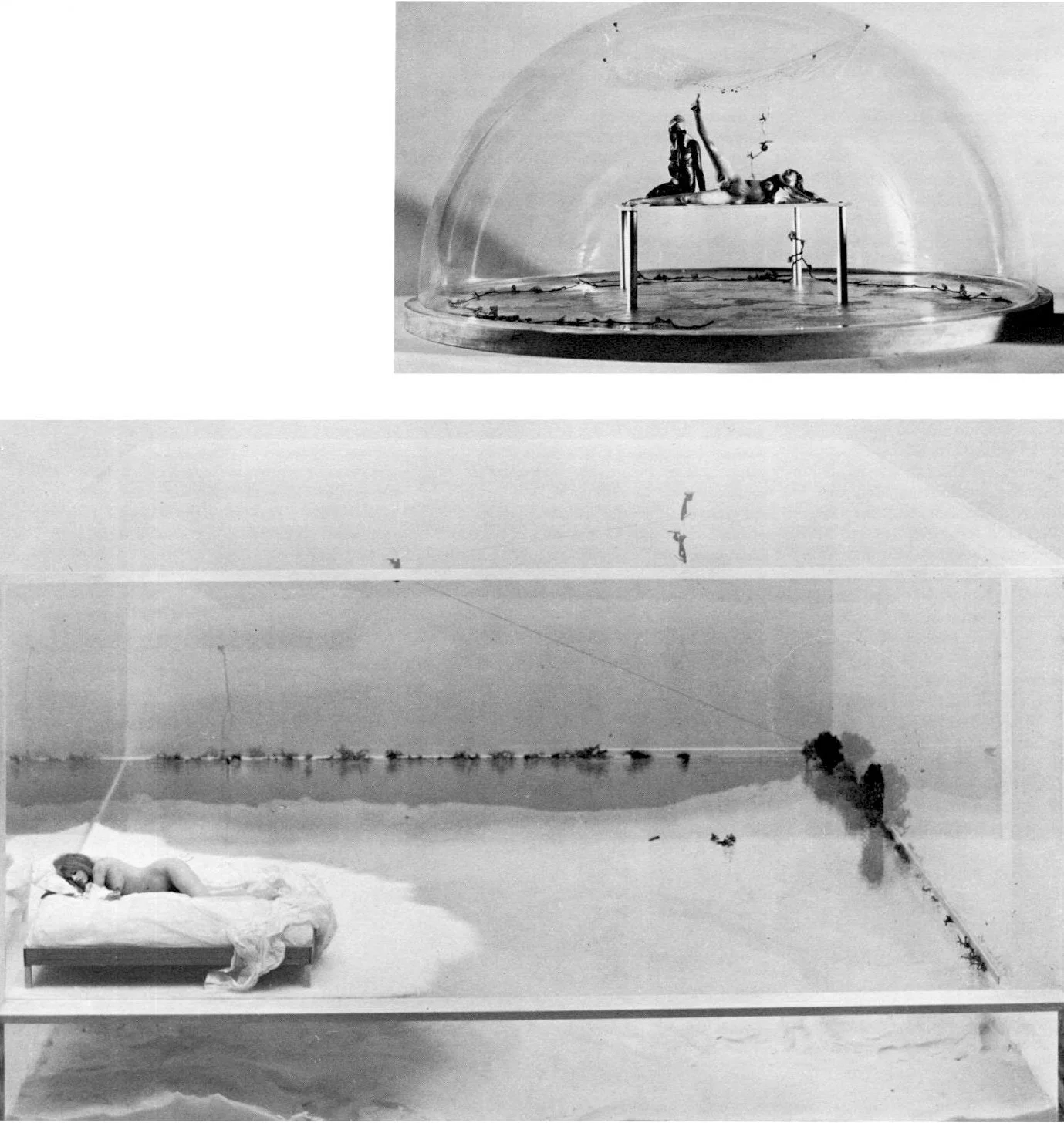
Image: Robert Graham. Untitled. 1969
Images
Brettell, Richard R., NOW/THEN/AGAIN: Contemporary Art in Dallas 1949-1989 (Dallas, 1989) [Design: Lidji Design]
Robert Graham sculptures are plexiglass, wax and various materials. 11" x 18" x 30"
More notes
Jupiter Water
We received a time capsule: water that predates Earth's oceans, preserved since the solar system's infancy and delivered to us from Jupiter.


On 22 March 1998, as seven boys played basketball near Monahans, Texas, a meteorite struck Ward County carrying 4.6-billion-year-old water trapped in purple salt crystals. This was the first extraterrestrial water ever captured on Earth: microscopic drops that had journeyed from an asteroid belt between Mars and Jupiter to land in West Texas.
One of the cosmic water meteorites was sent to NASA's Johnson Space Center for analysis.
Two stones, weighing 1344 g and 1243 g, fell in the city of Monahans, Texas, after two sonic booms and a fireball were observed over a wide area (up to 100 km from the fall site). One stone penetrated the asphalt on a city street and was found in the sandy subsurface.
I took these photographs around the Monahans dunes, one of the most beautiful places I have walked.
It looks like desert, but the sandhills are a semi-arid ecosystem where groundwater seeps up between 70-foot dunes, creating an entirely different world. Small oaks sink roots 90 feet deep to tap underground water, which stabilizes the dunes while badgers, kangaroo rats, and javelinas emerge at dusk to drink from the seeps. The forces that preserve water here are wind-carved sand acting as both barrier and vessel.
The Jupiter connection comes from the water itself, not the meteorite's origin. This meteorite carried "direct evidence of complex prebiotic chemistry from a water-rich world in the outer solar system" meaning the water and organic materials within it likely formed in the cold outer reaches beyond Jupiter's orbit during the early solar system, before being incorporated into asteroids that later migrated inward. It's the water that's from the Jupiter region, not the rock that carried it to Earth.
When such a rock strikes Texas sand, we receive a time capsule: water that predates Earth's oceans, preserved since the solar system's infancy and delivered to us. Space and time crystals.
September 12, 2025
—
Image: Zolensky and Bodner. Monahans chondrite with fluid.
More portfolios
Jordan Belson
A number of really beautiful, small paintings and one sculpture were made between 1955 and 1961.
Image: Belson drawings at Eugene Binder / Kendra Jones


While he was best known for making films, Belson also created a significant body of two-dimensional works throughout the later half of the twentieth century. These paintings, drawings, and objects reflect his consuming interest in sacred art, cosmology, and his lifelong engagement with eastern philosophies.
Working at the Morrison Planetarium in San Francisco from 1957 to 1959, Belson created flowing, pulsing visual experiences that dissolved the boundary between inner and outer space. His films like Allures and Phenomena used interference patterns, optical effects, and kaleidoscope projectors to generate imagery that felt simultaneously microscopic and galactic. His dome projections prefigured 360-degree visual environments.
It was a pleasure to see these drawings at Eugene Binder: the first ever solo exhibition of his visual art works.
Cindy Keefer on Jordan Belson, Cosmic Cinema, and the San Francisco Museum of Art:
In 1953 Belson attended Fischinger’s performance of his Lumigraph (a mechanical color-light performance instrument) at the museum. The Lumigraph was performed in pitch darkness, and Fischinger created what he called “fantastic color plays” with spontaneous movements of colored light dancing to accompanying music. Belson was struck by the simple elegance and the mysterious soft, glowing images. Similarly, Belson later saw one of Thomas Wilfred’s Lumia color-light machines exhibited at SFMA, which became an influence on his later work.
A few years after Art in Cinema, Belson and Henry Jacobs created the legendary Vortex Concerts.
In May 1957 the first Vortex Concert was held at the California Academy of Science’s Morrison Planetarium. Featuring new electronic music from avant-garde composers worldwide curated by composer and DJ Henry Jacobs, Vortex was described by Belson (as visual director) as “a series of electronic music concerts illuminated by various visual effects.” In the blackness of the planetarium’s 65-foot dome, Belson created spectacular illusions, layering abstract patterns, lighting effects, and cosmic imagery, at times using up to 30 projection devices.

Infinity - Jordan Belson. 1980
—
September 5, 2025References
Keefer, Cindy. 'Jordan Belson, Cosmic Cinema, and the San Francisco Museum of Art'. Open Space (San Francisco Museum of Modern Art), 12 October 2010. https://openspace.sfmoma.org/2010/10/jordan-belson/. [archived]
More portfolios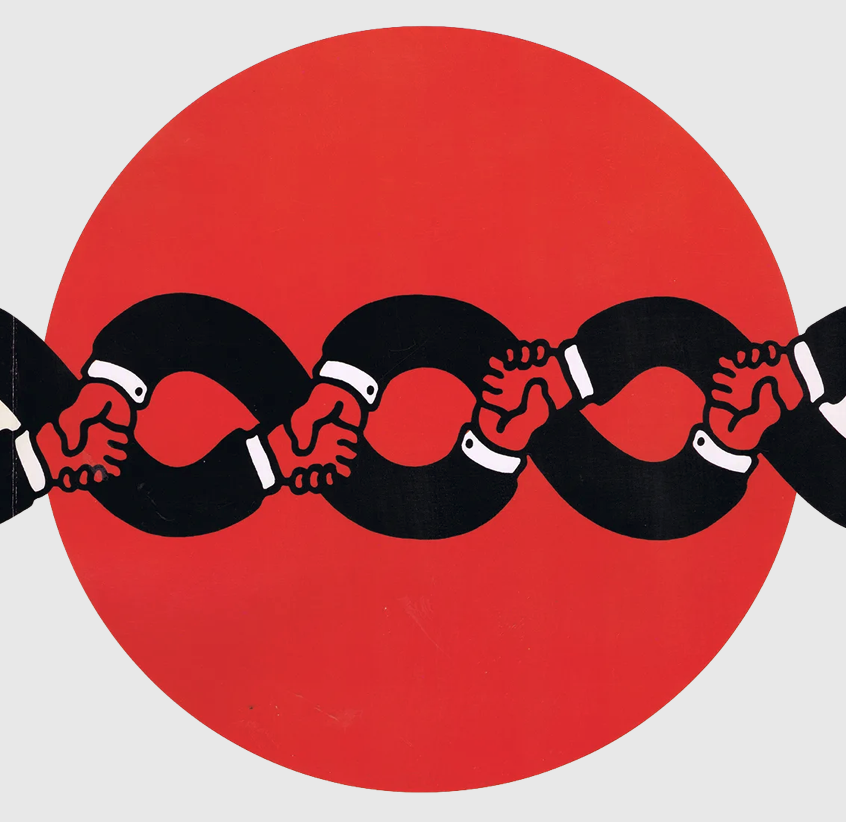
New Earth 21
Japan’s New Earth 21 was a century-scale premise in a revolutionary time.
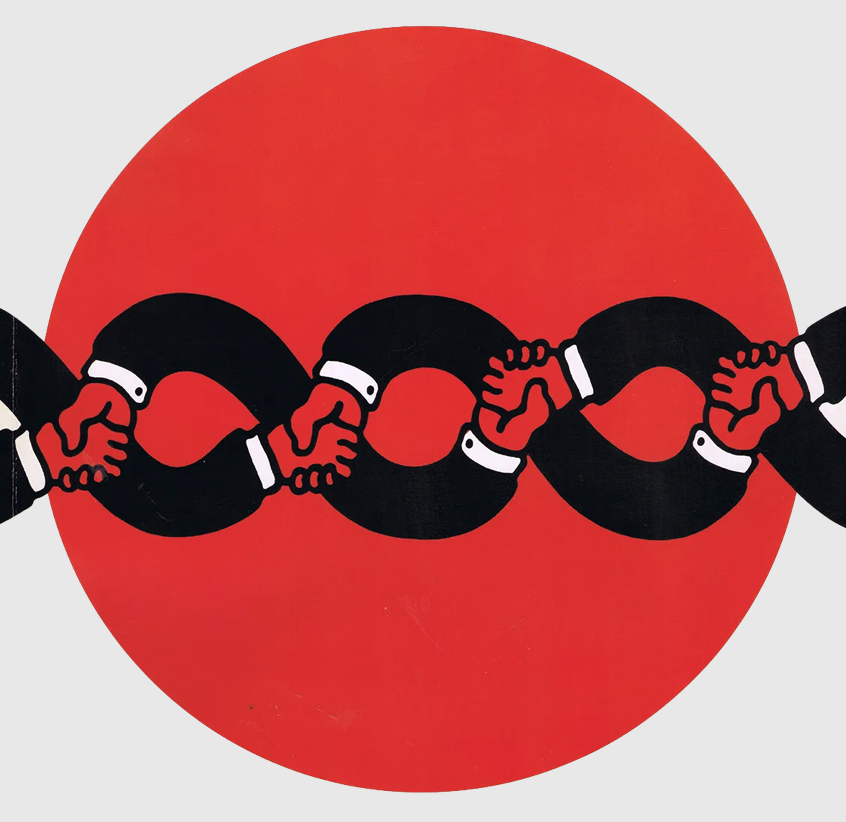
Image: アイデア IDEA Magazine. 1982
The year 1990 crackled with the energy of collapsing certainties. The Berlin Wall had fallen the previous November, Eastern European governments were toppling monthly, Nelson Mandela was released after 27 years of imprisonment by South Africa's apartheid government, and the Soviet Union was visibly disintegrating. Everything that had seemed permanent since 1945 was suddenly negotiable.
Environmental anxiety was becoming impossible to ignore. Two years prior, NASA scientist James Hansen had testified before Congress during a record-breaking heat wave, declaring with 99 percent confidence that human activity was warming the planet. His testimony made front-page news and brought “climate change” into public consciousness. The same year, the Intergovernmental Panel on Climate Change was established. By 1990, the scientific consensus was solidifying around a problem that seemed to demand immediate action, yet required solutions that might take decades to develop.
Japan found itself economically ascendant but geopolitically constrained. Japanese banks dominated global finance, its GDP per capita had surpassed America's, and its companies were on a buying spree, snapping up U.S. landmarks from Rockefeller Center to Pebble Beach, yet it remained locked within the constitutional and diplomatic framework of the postwar settlement.
Into this uncertainty came a moment of grand thinking. Japan announced New Earth 21, a 100-year plan to clean up the natural environment that had been degraded by human industry.
In other words, a scheme to save planet Earth.
The timing and methods are worth examining. Three months after Japanese Prime Minister Toshiki Kaifu sat with six other world leaders at the G7 Summit in Houston, where they proclaimed the necessity to protect the Ozone layer, Japan proposed nothing less than global environmental restoration.
This wasn't summit rhetoric. The Research Institute of Innovative Technology for the Earth (RITE), founded specifically for the New Earth 21 program in 1990, was institutional infrastructure designed to address worldwide environmental challenges across an entire century.
New Earth 21 consisted of five interconnected elements: energy conservation, alternative energy, environmental technologies, international technology transfers, and systems analysis. RITE served as the coordinating hub, bringing together researchers, engineers, and policy analysts to work on these challenges simultaneously.
The institute operated within the broader context of Japan's systematic approach to foresight, including the government's KIDSASHI methods for long-term forecasting (which I explore in a companion essay). What New Earth 21 specifically contributed was building detailed scenarios for how these technologies might be deployed globally. Rather than pursuing isolated projects, New Earth 21 was designed as an integrated system where breakthroughs in one area would accelerate progress in others.
What Japan proposed seemed to defy the logic of democratic governance and the revolutionary moment surrounding it. While the entire geopolitical architecture was being redrawn, Japan committed to century-scale environmental restoration with concrete backing. This represented a fundamentally different approach from either military power or economic dominance: authority based on scientific capability and moral responsibility for planetary repair.
The scale was genuinely global. The Japanese program was proposing to reverse two centuries of industrial environmental degradation through innovation. Preserve tropical forests, restore atmospheric balance, develop clean energy systems, green deserts, and do it all while maintaining economic growth. New Earth 21 positioned Japan as coordinator of this planetary rescue operation, offering both the framework and scientific solutions needed to address existential threats.
Most environmental programs operate through predictable project cycles. Politicians announce targets, diplomats negotiate agreements, and everyone hopes something gets implemented before the next election cycle changes priorities. Japan flipped this approach —they built the machine first. Establish the research institutes, hire the scientists, create the analytical systems, then figure out how to deploy permanent infrastructure for century-scale thinking, globally.
The timing reveals both Japan's strategic place in the new environmental diplomacy and the remarkable range of approaches to planetary challenges that converged in Houston that summer.
While the world's most prominent leaders gathered at Rice University and dined on tortilla soup at Bayou Bend mansion, on the other side of Houston at the modest Astro Village Hotel, a group of politicians, academics, activists, and populist leaders gathered at an alternative summit called The Other Economic Summit (TOES). The goal of TOES was to build an "international citizen coalition for new economics grounded in social and spiritual values to address concerns the G7 consistently neglects, such as poverty, environment, peace, health, safety, human rights, and democratic global governance."
Houston itself reflected this global ferment, made more intense by the sweltering July heat. Among the TOES guests at the hotel by the freeway was a metalworker named Luiz Inácio 'Lula' da Silva, decades away from becoming President of Brazil. The alternative summit was caught between competing demonstrations: a Cure AIDS Now rally that had narrowly avoided overlap with a KKK march, which faced off against anti-racist counter-protesters from The Human RACE (Racial Acceptance and Class Equality), featuring speakers such as former mayor Ray Hofheinz and NAACP representatives. Each group carried their own vision of America's future.
These grassroots movements, like their diplomatic counterparts, were increasingly thinking in global terms.
The contrast was telling. At least three different visions for addressing global challenges emerged from Houston in 1990. The G7 approach emphasised diplomatic protocols and international agreements. The TOES alternative focused on global organising and economic justice. Japan's announcement of New Earth 21 three months later represented a third way, one based on century-scale planning that transcended both diplomatic cycles and activist movements.
Why would a single country propose to solve problems for the entire planet? The impulse has a long history. Visionary individuals, international organisations, and ambitious nations have repeatedly offered grand solutions to global challenges, each reflecting their particular strengths and worldview.
Japan had been building toward this moment for years. Since the 1970s, it had refined sophisticated forecasting methods, including Delphi surveys, where panels of experts make repeated predictions about future technologies until they reach consensus. These techniques helped Japan anticipate which innovations to pursue and when they might become viable. South Korea adopted similar methods in the 1990s. Both countries used systematic future-thinking to guide their development strategies.
But planetary schemes extend beyond government forecasting. In the 1960s, designer Buckminster Fuller promoted his World Game concept, using early computer simulations to show how global resources could be redistributed to eliminate scarcity. The Club of Rome's 1972 Limits to Growth report used systems modelling to argue that unchecked development would hit planetary boundaries. More recently, scientists have proposed planetary boundaries frameworks that treat Earth as a single system requiring coordinated management.

Image: HMCJ / CSPAN. The Other Summit. 1990
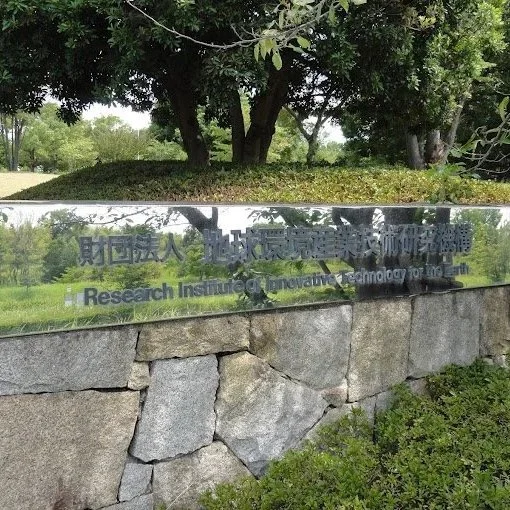
Image: RITE in Kyoto / 公益財団法人地球環境産業技術研究機構
What these initiatives share is the assumption that global problems require "global solutions", though they differ dramatically in their methods. Some emphasise changing human consciousness, others focus on better resource management, still others advocate technological breakthroughs.
New Earth 21 was distinctive because it combined the institutional commitment of a major economic power with an exclusively technological approach. Unlike most planetary thinking initiatives that emphasise social transformation or consciousness change, Japan's program avoided the messy work of changing how people think. It simply offered to build the technologies that would secure the future.
The entire enterprise rested on a massive assumption that rational solutions would inevitably be adopted. If the technologies worked, if the economics made sense, if the environmental benefits were clear, then implementation would naturally follow. This reflects a particular view of how change happens in the world, one that sees human behaviour as fundamentally logical rather than driven by emotion, politics, or cultural inertia. It's the kind of assumption that makes sense on the designer's page, but becomes more questionable when you're trying to reshape how eight billion people will live.
The program emerged as systems analysis capabilities made planetary-scale modelling more feasible. Humans could now better calculate global environmental flows, model interventions, and project outcomes across century-scale timeframes. The analytical capability to think "planetarily" had arrived and environmental stewardship offered a pathway to moral authority that transcended traditional geopolitical limitations. Unlike foresight processes that are inclusive and accessible, ensuring that diverse perspectives are integrated from the outset, Japan could, through New Earth 21 and other efforts at RITE, subtly position itself as the world's environmental problem-solver through scientific excellence alone.
New Earth 21 embodied a technocratic faith that engineering solutions could transcend political divisions. Japan had found its own approach to global influence through innovation rather than confrontation or social transformation. The logic was appealing. Build better technology and political arguments become irrelevant.
This required an extraordinary leap. New Earth 21 was audacious because it committed to technologies that didn't yet exist. Japan was placing a century-scale bet on breakthroughs that remained purely speculative in 1990.
The gamble proved prescient. RITE went on to develop world-leading technologies for capturing carbon dioxide from the atmosphere and storing it underground, something that, in 1990, was largely theoretical. The institute also pioneered sophisticated computer models for analyzing global climate systems. While New Earth 21 didn't explicitly anticipate artificial intelligence, it recognized that managing planetary systems would require computational power far beyond what existed at the time.
Japanese leadership understood something crucial about planetary-scale environmental challenges. They would require solutions that hadn't been invented yet. Rather than limiting themselves to existing technologies, they built the institutional infrastructure to develop breakthrough innovations over decades.
Importantly, New Earth 21 contained virtually no social or cultural considerations. The program’s premise was that scientific solutions, properly developed and deployed, could address planetary challenges without requiring changes in how people actually live, think, or organize their societies. Implementation was an engineering task rather than a social one. In their presentations, getting people to actually adopt these technologies appears as a simple point on a slide, as if the hardest part was inventing the solutions rather than convincing the world to use them.
This reveals something crucial about the psychology of proposing global solutions (and where looking back thirty-five years on a plan to extract the planet from environmental demise becomes increasingly poignant). They often reflect the proposer's strengths rather than the problem's actual requirements. Japan proposed scientific solutions because Japan excelled at innovation. Whether the problems were primarily scientific, rather than social or political, remained a secondary consideration.
Cathedral thinking in a revolutionary time
Cathedral thinking is about planning across multiple generations rather than single lifetimes, rooted in the medieval church's approach to building sacred architecture that would not be completed in one lifetime. Japan applied this approach to planetary stewardship precisely when everything else was changing by the month. One would expect that most revolutionary moments produce short-term thinking and immediate responses to urgent crises. New Earth 21 did the opposite, creating the longest time horizon for addressing the ultimate long-term crisis.
The program's unusual name, either by coincidence or intention, hints at deeper currents. New Earth 21 echoes the biblical Revelation 21, which promises a "new heaven and a new earth" after the first earth has passed away. Whether consciously or not, Japan's century-scale vision of planetary restoration carried theological undertones that its purely technological veneer might not immediately suggest. The idea of systematically repairing a damaged world through human effort reflects themes that run deeper than engineering alone.
RITE has since achieved world-leading breakthroughs in carbon capture, bio-refinery systems, and climate modeling. Looking back, it is remarkable how rational the mandate of New Earth 21 was in 1990. The scientific capability existed. The institutional framework was built. The international cooperation mechanisms were established. The promise made at that Houston summit led to Rio in 1992, then to a succession of climate conferences: Kyoto 1997, Paris 2015, and dozens more. The feasibility was proven; the collective adoption was not.
New Earth 21’s premise stands out even more starkly today. While a few other century-scale projects exist, such as nuclear waste repositories designed to last 10,000 years, the Svalbard Seed Vault, and the Long Now Foundation's 10,000-Year Clock, most focus on preservation rather than active planetary management. New Earth 21 remains one of the most ambitious examples of governmental cathedral thinking in modern history.
Thirty-five years after that sweltering July in Houston, RITE continues operating, still producing environmental research and technological solutions. The program reveals both the possibilities and limits of long-term institutional planning.
There's something profound about this kind of speculation: being compelled to plan furthest into the future precisely when we know least about what that future holds. The greater the time scale, the greater the uncertainty. Whether such planning represents human hubris, practical necessity, bureaucratic folly, ecological philosophy, or simply the mundane work of governance depends largely on one's perspective.
What remains, today, is the apparent urgency of the same question from 1990. The question is whether such comprehensive, long-term environmental planning is collectively achievable.
August 29, 2025—

Zenmai (Clockwork) - Susumu Yokota 横田 進 from Acid Mt. Fuji. 1994
A beautiful sound from Yokota that merges Japanese new age, house, and minimal techno and the birth of a new scene in Japan emerging during the Employment Ice Age, where the so-called "Lost Generation" came of age during the economic stagnation following the 1990s economic bubble bursting. Remastered on Sublime.
References
The Rice Thresher (Houston, Tex.), Vol. 78, No. 1, Ed. 1, Monday, June 4, 1990.
Climate Justice Museum, 'The Voice of a Changed City: How the 1990 Other Economic Summit Changed the Environmental Justice Movement in Houston', Climate Justice Museum, https://www.climatejusticemuseum.org/blog-posts/the-voice-of-a-changed-city-how-the-1990-other-economic-summit-changed-the-environmental-justice-movement-in-houston, accessed 29 August 2025.
Images
IDEA Extra Issue – The World’s 10 Poster Artists Exhibition. A catalogue of the exhibition held at Nihonbashi Takashimaya in 1982. It features 30 works by five of Japan’s leading designers, including Nagai Kazumasa, Tanaka Ikko, and Yokoo Tadanori, and Holger Matthies, and Milton Glaser, for a total of 300 pieces. Under the theme of “Protect the Green, People, and Earth,” 10 designers with unique personalities and talents competed, and the collection of works is overwhelming. Even a universal theme cannot be expressed universally because the qualities, styles, and techniques are completely different. Publisher: Seibundo Shinkosha
アイデア 世界の
ポスター
10人展
Stills from C-SPAN footage of The Other Summit. From Houston Climate Justice Museum. 1990
More notes
Kohoutek
It’s the future! A new opportunity to create relationships with change, rather than just commentary.
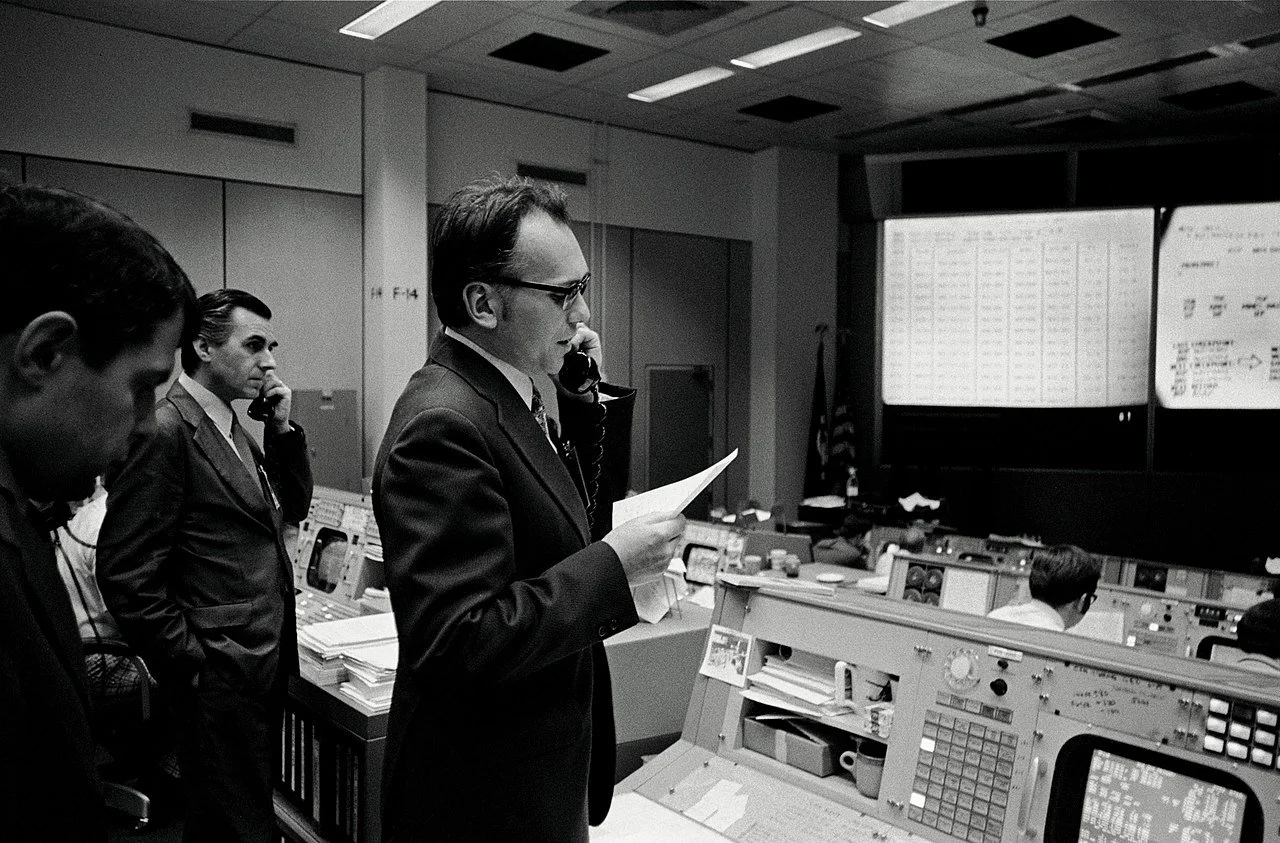
Image: Luboš Kohoutek talks with Skylab 4 astronauts from Johnson Space Center, Houston. 1974

Image: Skylab 4 astronauts confer via telecom with Earth.
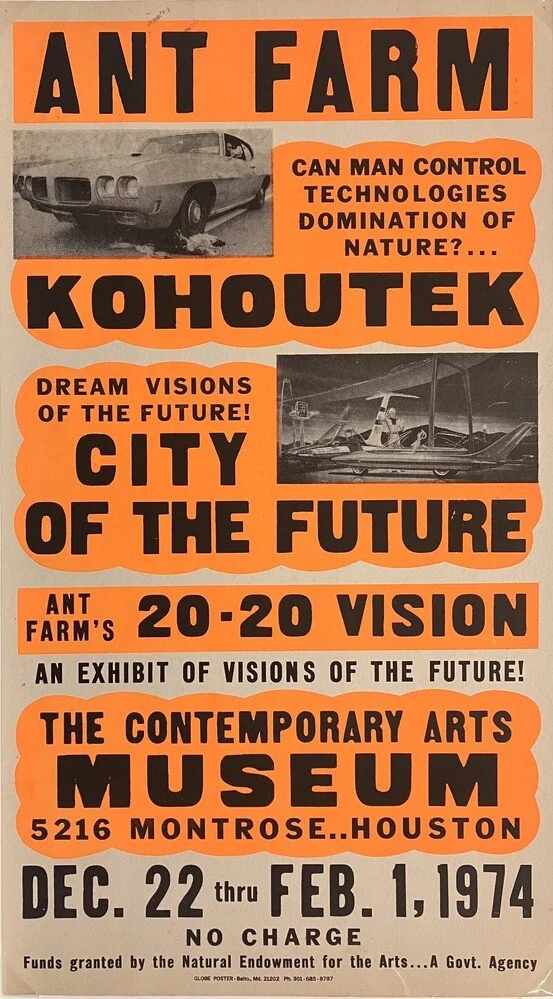
Image: Ant Farm at CAMH. 1973-1974
Winter 1973 delivered two Kohouteks, one a cosmic disappointment and the other a brilliant act of architectural theft. That year, the Comet Kohoutek, named for discoverer Luboš Kohoutek, was expected to be a celestial spectacle visible in daylight, outshining even Venus. William Safire, writing in the New York Times, predicted the so-called comet of the century would be one of the biggest, brightest, most spectacular astral displays that living man has ever seen.
By the summer of 1973, sales of telescopes quadrupled, religious fundamentalists interpreted the comet's arrival as being a harbinger of God, psychiatrists said the impact on patients had already been "profound", Carl Sagan was invited to The Tonight Show Starring Johnny Carson to discuss the new cosmic age, and comet-themed merchandise and apparel was in demand.
But when it finally arrived, Kohoutek proved far dimmer than expected. Bright enough to see, but far from the exuberant projections that had captured public imagination. Kohoutek became synonymous with spectacular disappointment.
The month the comet had been predicted to reach maximum brightness, December 1973, the art and architecture collective Ant Farm opened their own Kohoutek exhibition at Contemporary Arts Museum Houston (CAMH). Alternately titled Exhibit of Visions of the Future, A Scan on Tomorrow, 20/20 Vision, and Visions 4-2MAR0, the wordplay in their printed ephemera was an obvious but brilliant appropriation: "KO - knockout, HOU - Houston, TEK - tech".
Ant Farm had formed in 1968 when Doug Michels, a Yale architecture graduate, met Chip Lord while guest lecturing at Tulane, where Lord was studying architecture. The two founded their collective in San Francisco, then eventually moved to Houston as visiting professors at the University of Houston. There, Michels and Lord planned free-form events such as trips to the beach to play with giant inflatables, a downtown scavenger hunt, and a sleepover in the Astrodome with parachutes suspended by helium balloons.
They weren't dropouts from serious practice but serious practitioners who had abandoned professional conventions. In California they had built big inflatable environments using cheap fans and polyethylene (picture inflating a plastic grocery bag, but at scale). Their hundred-foot-square "pillow" was used as the medical tent at the Altamont Speedway Free Festival in 1969.
As trained architects and artists, Ant Farm possessed something most futurists lack: the ability to draw, blueprint, and physically craft their speculations. While academic and professional futurists work with probability curves and scenario matrices, Ant Farm created architectural drawings, installation plans, and visuals that made abstract possibilities tangible. They could draft technical specifications for impossible (so far) buildings and hammer speculative futures into floor plans.
While astronomers and the media narrowed their calculations around a magnificent orbital and cultural possibility, and got it famously wrong, Ant Farm were considerably looser in their imagination. At CAMH they produced predictions saturated with play, creating tangible and gently ridiculous expressions of our relationships with American past, present, and future.
Their 20/20 Vision - Kohoutek exhibition folded time and inflection points together, mixing allegory and reality. A 1959 Cadillac convertible sat in the gallery, while visitors could look through round portholes into The Living Room of the Future and see an active video feed from Skylab, the United States' first space station, where, at the same time, astronauts might have been conferring over cosmic distances with a deflated Luboš Kohoutek.
Teleportation and biology fused in the museum presentation, and surveillance was imagined by the architects as a gland, part machine, part living organism, monitoring evolution. Their playfulness was genuinely strange, and never preachy. The Doll House of the Future in the exhibition hosted a colony of Barbie dolls with access to an experimental sperm bank, while all intelligence was imagined to be collected in a brain bank made of living tissue laced with electronic amplifiers controlled by insects (ants of course). Ridiculous, certainly, but not superficial.
"Any useful idea about the futures should appear to be ridiculous," says futurist and educator Jim Dator, because "what is popularly, or even professionally considered to be the most likely future is often one of the least likely futures". Ant Farm had by 1973 already established a consistent track record of being both ridiculous and prescient.
But the infinite expanse of "anything can be anything" futurism, especially for artists, is easy to get lost in. Ant Farm avoided this kind of total untethering. Unlike freeform hallucinations that treat the future as a blank canvas, they anchored wonderment to observable technological developments. In California, they practiced optimistic pessimism, reflecting their belief that too many architects were waiting to see what technology NASA and various defense projects would produce. In their Inflatocookbook they appealed for exchange between scientists, manufacturers, architects, and social administrators in investigating new material applications and technology.
Crucially, they avoided lecturing or hardening into total satire. Nothing in 20/20 Vision feels mean or proposes an overwhelming sociology assignment. Their invitation to visitors was to get on a warped freeway with them and steer through a constellation of emerging realities.
The Information Age was gaining momentum the year of their CAMH show. Electronic innovations, breakthroughs in data storage and display technologies, expanding satellite networks, and shifting cultural attitudes converged to fuel widespread anticipation about what was "just around the corner".
Information and its movement was the connecting thread between these developments, and theorist Marshall McLuhan's writings on mass-media intuited a collapse of traditional boundaries between here and there. Ant Farm positioned themselves not as detached critics but as engaged interpreters, responding to the new personal computing industry emerging in their own region.
Houston, where they found themselves working, had become America's clearest expression of flow-based urbanism. The first official document to guide the city's future was a thoroughfare plan put together in 1942, a mere three decades prior to the CAMH show. The future was rendered as traffic. Transportation remained the organizing framework for Houston into the 1980s, and growth revolved around moving people and things efficiently: freeways threading through subdivisions, the ship channel pushing material toward the Gulf of Mexico. Johnson Space Center and NASA, rocketing people to the moon and back, carried forward this logistics theme.
Ant Farm's work naturally drew from this car culture vocabulary. The 1959 Cadillac and line of gas pumps inside CAMH, their earlier Media Van projects, Truckstop Network (which proposed highways creating new information networks), and later on their Cadillac Ranch in North Texas (and maybe, too, their worksheets for the World's Longest Bridge and World's Fastest Turtle) all rearranged the language of transportation-aspiration.
The link between physical flows and information flows wasn't explicit, but it was there. "Image mobility will replace physical movement," predicted Michels in 1978. This position would lead him to co-found Universal Technology with artist Alexandra Morphett, a company that seems to have produced no actual products but instead toyed expertly with how information networks might reshape cities and, audaciously, the universe.
In nearby San Antonio, Texas, engineers Phil Ray and Gus Roche, who worked on various NASA programs, including the Apollo missions to the moon, founded Datapoint Corporation in 1968. Their ambition was to have a piece of the technological future, and they would do this by developing products that moved information around.
Datapoint existed to solve efficiency problems, the opposite of play in spirit and process. Their prototypes and terminals were things someone could respond to and build around. In Texas there began to be tangible and physical elements for techno-folk collage, and the future wasn't just an abstract possibility. In other words, there existed a new opportunity for artists, architects, scientists, or tinkerers to "hook in" and create relationships with change, rather than just commentary.
Enter Universal Technology, who, delightfully, convinced these serious-minded engineers to hire them for their Corporate Data Station project.
Universal Technology's core identity is not easy to decipher. On blueprints they called themselves The Creation Corporation, and they operated in an unusual domain where experimentation, pranking, techno-utopianism, and straight-faced entrepreneurship weren't mutually exclusive.
They called what they were doing "pre-enactment," a sophisticated alternative to random speculation. Their 1979 design for the Corporate Data Station described a structure that rehearsed the future of networked computing, including a Datavision media system of screens and audiovisual equipment, word-processing offices, and housing for networked Datapoint computers. Users could enjoy tangible, tactile interfaces and the whole thing existed in a nautical form, like the bow of a boat, made of aluminum tubes wrapped in lightweight nylon.
A cold reading might be that pre-enactment was an elaborate word that simply meant play, and the Corporate Data Station was just cubicles. The Data Station looked like a combination yacht and a space capsule, suggesting nautical movement and aerodynamic efficiency. A generous aesthetic gift to the work of word-processing contained within it.
It's tricky to surmise whether their plans to headquarter their company in the Philip Johnson-designed Two Post Oak Central building in Houston's Galleria district was serious or absurd: while simultaneously designing satellite-enabled workstations suitable for corporate contracts and factory production, they had a growing obsession with dolphin-to-human interchange and dreams of a watery interspecies "embassy" for dolphin-human communication. (Official dolphin embassy letterhead was printed). Later Michels would propose Bluestar, a glass space station operated jointly by humans and dolphins.

Image: Philip Johnson-designed Two Post Oak Central

Image: 2020 Vision at CAMH ephemera. 1974

Image: Ant Farm’s Dolphin Embassy
The connecting line was networking technology that would entirely reshape both human communication and work patterns, as well as our relationships with animal intelligence. Academics might now call this Animal-Computer Interaction (ACI), more-than-human design, or critical posthumanism. Universal Technology was experimenting with concepts decades before academic terminology formalized.
Universal Technology, skilled at image-making and branding, were valuable enablers and collaborators. Both companies understood that naming new or unproven technologies shapes how people think about them. Datapoint had its own adventure with terminology when, amazingly, they initially planned to call their ARCNet system "Internet," but switched the name just weeks before launch, worried that customers would reject something that sounded too complex.
Working alongside architect Richard Jost, Michels created the most precise and prophetic example of these combined skills through a private commission from Houston patron E. Rudge Allen. The project showed their approach to playing with the moment. Allen wanted to stay ahead of the technological curve. While Allen wanted to turn time into money, the architects turned Allen's money into a sofa that talked to space. Possibility actualized, and upholstered.
They called it a Teleportation Unit, alternately Media Room, and it combined computing, telecommunications, media projection, and comfortable seating. In blueprints it sits right next to an open floorplan kitchen, dining room, and living room. One of the first, if not the first, Apple II series computers in Houston is on the desk in publicity photos. The term teleportation unit captured what the technology promised (being elsewhere instantly) while making it sound like the future made real.

Image: Richard Jost / Belle Magazine. 1980
The unit essentially anticipated remote work, and would be one piece of the eventuality they imagined: thousands of cities connected to Eden Satellite systems. This built upon Ant Farm’s earlier proposal for an experimental city of 20,000 people between Dallas and Houston, which they presented at Rice University in 1972. The teleportation unit was a prototype for how people might live and work in such networked settlements.
When Ant Farm subtitled their CAMH exhibition Kohoutek, they were betting on cosmic spectacle. The comet was supposed to be the show of the century, and the architects couldn't have known it would fizzle. But they had grasped something special about scale and invitation. Like presenting a prospectus for a new city in Texas, spectacle, at any level, even anti-spectacle, resonates if it remains participatory rather than prescriptive. And they understood McLuhan: "The future of the future is the present, and this is something that people are terrified of.”
The future recedes relentlessly. Even the most astute targets recede and ambitions deflate in unpredictable ways. Astronomers plotted probable brightness, projecting a spectacular show. What they got instead was a lesson in the limits of prediction. The social obsession with Comet Kohoutek would later echo in Year 2000 Problem (Y2k) anxiety. Both are moments when collective anticipation far exceeded what came to be.
Houston, and Datapoint, learned this painfully. The year of Ant Farm’s CAMH show kicked off a Texas oil boom, peaking when one in every 20 commercial Bell helicopters sold on the continent were flying above Houston. When prices dropped to earth in the 1980s, the city was in such bad shape people facing foreclosure gave the banks the keys to their homes and walked away. Datapoint’s arc lifted them to a Fortune 500 company down to bankruptcy in 2000, after losing hundreds of millions of dollars in market value during a 1980s accounting scandal.
Rather than mapping futures from a distance, Ant Farm and Universal Technology give us clues about how to create relationships with emerging realities. The point is not that they had discovered a replicable methodology for futures thinking or even visualization. It is that they were actually good at play: genuine, unforced, and driven by curiosity.
This is harder than it sounds. A sleepover in the Astrodome is, in 2025, the stuff of corporate offsite dreams. The awkwardness of contrived ideation sessions and team-building exercises only highlights how naturally play and fun came to Ant Farm and the people associated with the collective. Wonder resists over-engineering.
Poetically, much of Ant Farm’s archives were destroyed in an unpredicted storage fire. Michels, who died in 2003, was still working on the future at the turn of the millennium, developing a hundred-year vision in a University of Houston seminar called Houston 2100, which addressed the city’s flooding problem. And Allen, the patron, died sitting in his Saarinen chair in the room where the teleportation unit had once promised he could be anywhere.
August 15, 2025—

Video: We Make Computers. Datapoint. 1978
References
Dewan, Shaila. 'Back to the Futurist'. Houston Press. 16 December 1999. https://www.houstonpress.com/news/back-to-the-futurist-6565939?showFullText=true.
Flyntz, Liz. 'Ant Farm's Visions for 2020: A Wilderness of Tomorrows'. Vesper. Journal of Architecture, Arts & Theory 3: Nella Selva | Wilderness (Fall-Winter 2020): 175-183. https://doi.org/10.1400/283007.
Lazowska, Edward D., Henry M. Levy, Guy T. Almes, Michael J. Fischer, Robert J. Fowler, and Stephen C. Vestal. 'The Architecture of the Eden System'. Department of Computer Science, University of Washington, Seattle, 1981.
Nakamura, Randy. 'The Architect as Corporation as Media: Doug Michels, Alexandra Morphett, and Universal Technology, 1978–1980'. In Play with the Rules: 2018 ACSA Fall Conference Proceedings, p. 159. 2018.
Oettinger, Anthony G. 'A Convergence of Form and Function: Compunications Technologies'. In The Information Resources Policy Handbook: Research for the Information Age, edited by Benjamin M. Compaine and William H. Read. MIT Press, 1999. https://doi.org/10.7551/mitpress/3771.003.0008.
Images
Dr. Luboš Kohoutek, discoverer of the Comet Kohoutek, is seen in the Mission Operations Control Room in the Mission Control Center during a visit to Johnson Space Center (JSC) in Houston. He is talking over a radio-telephone with the Skylab 4 crewmen in the Skylab space station in Earth orbit. Dr. Zdenek Sekania, who accompanied Dr. Kohoutek on the visit to JSC, is on the telephone in the left background. Dr. Sekania is with the Smithsonian Observatory in Cambridge, Massachusetts. NASA Identifier: S74-15064
The three members of the Skylab 4 crew confer via television communication with Dr. Luboš Kohoutek. This picture of the three astronauts was reproduced from a TV transmission made by a TV camera aboard the space station in Earth orbit. They are, left to right, Gerald P. Carr, commander; Edward G. Gibson, science pilot; and William R. Pogue, pilot. They are seated in the crew quarters wardroom of the Orbital Workshop. NASA Identifier: S73-38962
More notes
Future Shock in Place
The story so far is that it is good, it will be better. This does not correspond to the experiences of the majority of inhabitants of the world. If it is so good, then why is it so bad?

Image: Nowy / New poster for film by J. Ziarnik. 1970
"We face a period as traumatizing as the evolution our ancestors had to undergo changing from sea creatures to land creatures. People who manage to adapt will adapt; those who do not will vegetate at a lower level of development or perish, cast ashore by the waves" - Lawrence Suhm, University of Wisconsin.
The main thesis of Future Shock (1970) is the claim that this period has already begun, and its author attempts to determine the character, scope and striking power of the "tomorrow's world" explosion that is taking place among us.
The acceleration of civilization's developmental process and the pace of changes in the human condition have passed so much "from quantity to quality" before our eyes that the word "explosion" has an almost literal meaning, and the titular future shock has been applied in the book in an almost hospital-clinical sense.
A fashion for futurology and various revelations under the sign of "do you know that..." has become quite an irritating cliché for some time. "Every age is a turning point" wrote Karol Irzykowski 50 years ago. But this book deserves attention not so much because of the colorful visions of the future, with which as a rule every work of this kind amuses, confuses and frightens, but because Toffler tries, among other things, to explain what is happening hic et nunc: ready-made and intellectual madness, the coexistence of computers and astrology. And above all the fact of humanity's growing possibilities as a species and the equally clear sense of deepening impossibility for humanity as individuals of flesh and blood.
"The collective value has burst, so to speak." We could describe this collapse using Czesław Miłosz's words, or understand it through Toffler's diagnosis of an adaptive crisis: future shock.
It must be stated immediately that the quantity and type of attention devoted (or devotable) to this best seller on both sides of the Atlantic depends on the place where one reads Future Shock.
The actualising factor, or conversely the this-still-doesn't-concern-us-much attitude, is the probability, scope and pace of changes in the world surrounding us. In the United States, the author's homeland, the accumulation of contrasts, diversification and changes, or to speak Polish in the American way, praaablems (necessarily with three a's!), is daily bread by no means sweet. The book addresses issues that are most definitely NOW.
In our society the 'natural course of things' consists in the rhythm of changes undergoing constant acceleration, bringing people and institutions to the ultimate limits of their adaptive capacities," notes Erik Erikson in a book devoted to youth problems in the United States. Indeed, in this country the issue of daily adaptation concerns everyone. In America futurology has reached the street.
The reaction to the book in other regions of the world will undoubtedly be different.
In Western Europe its subject matter belongs to matters with the status of 'yes, undoubtedly, certainly, soon', but one can still return to the same house for the same steak with fries and console oneself that tout fin ira bien par avoir une fin (or will it?!). In the Eastern bloc, against the background of geological shifts barely perceptible to the individual eye on a daily basis, it may even cause irritation, as shown by the hero of one of satirist Sławomir Mrożek's short stories who says, You say progress, progress! and here the dwarfs are pissing in our borscht!
One could therefore wonder where, between that bread and the borscht, the true relevance of the book is placed. Toffler bets without hesitation on American bread, claiming that it will become commonplace on a global scale sooner than we expect.
It was mentioned above that the value of the discussed book lies, among other things, in its explanatory qualities regarding contemporary times. To explain something means to refer to a more general theory, just as we explain the falling of a single stone by referring to the law of gravity, which constitutes part of physical theory. Toffler's theory, if we accept it, explains the above-mentioned differences in the relevance of the book depending on location on our globe.
According to the author of Future Shock, three epochs coexist side by side in the world: past, present and future. About 70% of the world's inhabitants still belong to pastoral-agricultural civilisations. These are people of the past whose way of life, work, level of knowledge, in short, their world, is constantly shrinking, giving way to industrial civilisation, such as 25% of humanity knows. This is a civilisation with industry prevailing over agriculture, with time measured by clock and factory siren, not by seasons. A civilisation of people segregated into narrow specialties and surrounded by things.
Through them and among them has begun an increasingly clear process, most often called the second industrial revolution, which Toffler prefers to call the beginning of the super-industrial era. Its features are growing automation, increased mobility of people and institutions, swelling quantum of information circulating in the world, and awareness that the world is changing faster and faster.
Increasingly visible becomes the still smaller group of people of the future. Technicians, managers, scientists, increasingly rapidly changing positions, continents and friends. Most of these people are found in America and on quite specific routes: the northern one leading toward the American scientific and industrial centres of the East Coast, and the southern one toward the increasingly rapidly developing and densifying California. Their lifestyle, thinking and work, and the style of being of institutions with which they are connected, constitute for Toffler a guideline according to which he orients his forecasts for the future and his diagnosis of contemporaneity.
Past, present, future are not merely units of diachrony: as living conditions and concepts of the world they coexist synchronically, though the boundaries between them become increasingly thin. Acceleration of development causes the future to arrive faster and faster and increasingly often finds us in place, unprepared. This often unwanted confrontation is precisely future shock. To determine more precisely what it consists of and how to mitigate the force of its impact, let us see how this future is supposed to look.
According to Toffler, the super-industrial epoch into which we are entering can be characterized by three key terms: ephemeral, innovation, diversification.
The word ephemeral applies to the environment, to objects of perception, as 19th-century philosophy would define it; subjectively it means the impression of the provisional nature of everything around us. Wherever we are, we are only tenants of furnished rooms.
Trying to define the concept of ephemeral more precisely, Toffler observes that what we usually call the world consists of five elements: things, places, people, institutions and ideas. One can speak of the level of ephemeral, measured by the durability of our relationship to these elements.
The so-called present times are characterized by increased and constantly accelerating rotation of relations: human-human, human-thing, and so forth. In other words, the mentioned objects of perception wear out faster now. Contemporary society is increasingly a civilization of throwaway things.
Starting from cans and Kleenexes and ending with cars, things serve… then are thrown away. This undoubtedly happens because automation of production lowers the price of an object below the cost of renovation. Thanks to this, new shoes cost less than repairing old ones. But there is also a shift in the psychological concept of the object where essence becomes less and less important, and function more and more so.
A house is a place where one lives with family. Since the family grows, the house should be enlarged, rebuilt or another one bought. We preserve only the function of the house, not a given complex of bricks. We apply the principle of modularity by exchanging parts we preserve the whole. In our example, house is the whole (function plus concrete building), and we exchange the latter while still preserving the function.
The house is a good example because it is an almost symbolic object, also in America, and its possession was always a sign and generator of stabilization and rootedness. Not accidentally, the peak of domestic lyricism in England (Tennyson) falls in the mid-19th century, the period of industrial revolution and migrations of population from native places to cities. In the United States, the cult of one's own house was a continuation of English tradition, and additionally became distinctly established as a symbol of shelter and security during the Great Depression.
Currently, attachment to the house begins to diminish. According to data from the author of the discussed book, in 1955 apartment buildings constituted only 8% of all construction activity in the United States; in 1964 already 24%, and in 1969 for the first time in this country's history more of them were built than single-family homes. The tendency toward non-commitment begins to dominate, due to the increasing mobility of people working in super-industry, namely new companies organized on new principles. A company joke among IBM employees, the largest computer manufacturer, explains the company name as an acronym for I've Been Moved.
The tendency to rent instead of own draws increasingly wider circles. Hertz Rent-a-car already provides millions of people with cars at the time and place chosen by them, without the troubles associated with buying, maintaining, and finally disposing of one's own car. The mentioned IBM rents computers, similarly Xerox copying machines. In the long run this principle can revolutionize economics, radically changing the producer's relationship to the manufactured product. The stimulus for achieving truly maximum quality of the object will become not only competition, but above all the threat of mass return of borrowed objects in case customers are not satisfied with them.
In the final analysis, there occurs not only an acceleration of the rotation of the human-thing relationship, but the very character of this relation undergoes change. Property, defined in Roman law as ius utendi et abutendi, becomes split into basic components, giving ius utendi to the sublessee, and concern for the dangers of abutendi to the producer.
One could discuss the positives and negatives of these changes. Toffler observes that many critics of contemporary times behave as if they cannot grasp the principle that you cannot eat your cake and have it too. The same people who lament the civilization of things and materialism simultaneously moan about the depersonalized relationship to these same things.
Depersonalization is the price paid for mobility, which in turn is an inseparable component of ephemeral civilization. Increasingly changing technology, organization and production goals cause personnel to increasingly have to move from place to place. The awareness that in two years, one year or 3 months we will no longer be here causes people to try to arrange things so they can leave without excessive troubles, material and psychological.
The emigrant, nomad and traveler have a different mentality than settled people. The fact that in one year alone (March 1967 - March 1968) nearly 37 million Americans changed their places of residence does not remain without a trace, especially in the area of views on what is commonly called normal life.
For the average European, the uprooting of Americans seems something strange, inhuman, and at best worthy of pity. Toffler points out, however, that Europe too is becoming a territory of wanderings of new nomads. One need only mention the hundreds of thousands of guest workers from Southern Europe. Mobility necessarily becomes a point of view after some time.
Ernst Dichter, an American authority in the field of motivation research, writes about inhabitants of countries at the threshold of the super-industrial era that most of them have already eaten their fill and have a decent roof over their heads. Now after realizing this eternal dream of humanity they seek new satisfactions. They desire to travel, discover, enjoy greater independence, at least physical. The car has become a mobile symbol of mobility. In a certain way, Marinetti's futuristic provocation is fulfilled when he claimed the car is more beautiful than the Nike of Samothrace.
We said that the ephemeral consists in increasingly rapid rotation of man's relationship to the elements. One of them are Sartre's others, and one of the main charges (against whom actually?) is the dehumanization of human-human relations. Let us pause for a moment on this issue, first because it is interesting in itself, second because it well illustrates Toffler's rational-empirical attitude.
The depersonalization of average interpersonal contacts (the proverbial stewardess smile) is a fact. In a large city a person cannot enter into equally intimate contacts with fellow humans as a member of a small group, simply because there are too many such contacts. A few years ago, one of the sociologists from MIT asked his students to note the number of all new people they would encounter in 100 days. This figure ranged from 500 to 2,500. It is a physical or at any rate psycho-physical impossibility to maintain relations of total engagement with such a mass of people. It would lead to total disintegration, that is, simply madness of the person attempting such a feat.
One must agree with the opinion of theologian Harvey Cox that a person not only has the right, but even should maintain with the majority of people who find themselves on his path, relations more or less impersonal —precisely in order to preserve the ability to choose certain friendships that he intends to cultivate and develop. This fact is generally not taken into account by advocates of global engagement with another person. Toffler observes that fulfilment of this ideal would not only lead to disturbances of our internal balance, but above all would very much limit our freedom. And it is precisely the majority of writers complaining about the superficiality of interpersonal relationships who are simultaneously in the ranks of zealous defenders of individual freedom.
Sentimentalism in treating human nature obscures the fact that every engagement increases the number of expectations and hopes of reciprocation, and thus also pressure in that direction.
People living in more integrated groups, for example in the provinces, know all too well the totalitarianism of such groups and the number of conventions to which they must submit in exchange for acceptance, or at least a more or less neutral attitude from their environment.
The observed dehumanization of the world at increased speeds is, in Toffler's terms, yet another application of the principle of modularity. Our relationships with the growing number of people in our environment are based mainly on their functions. For example, when buying shoes we treat the salesperson in the store precisely as a shoe salesperson, and we end our interpersonal relationship the moment we step out onto the street.
Of course one can say that the person in this arrangement becomes yet another throwaway thing, but in the end this is only a negatively coloured formulation of the inevitable fact that only at this price can we manage to live at all on our overpopulated globe, and perhaps enjoy greater personal freedom.
Every civilisation has its duration scale, namely the average duration of a given activity or state. Conflicts between civilisations or generations have as their foundation, among other things, different duration scales. For the average Frenchman, Americans are barbarians devouring a sandwich in 10 minutes, instead of delighting in eating for an hour and a half, which in turn for a normal American is an idiotic waste of time in the middle of the day.
In pre-technological civilisation the duration of normal stay in one locality was a whole lifetime because people were born and died in the same village. This same duration in the United States currently averages 4 years and is constantly shortening. Similar differences in duration scale exist in the field of interpersonal relationships, which is particularly visible in the epoch of ephemeral. Through premature extrapolation one can reach the conclusion about the disappearance of all bonds between people, which is not true.
Cautious optimist Toffler draws attention to the positive aspect of the acceleration phenomenon. Thanks to modular relationships with people we have greater possibilities of choice. One could again speak of increased freedom, consisting in departing from the rather sad rule that if you don't have what you like, you like what you have.
Against this background, the observation of English psychologist Sargant Florence looks interesting, who calculated that for a person with university education to be able to form 20 truly interesting and enriching friendships, natural selection from among a million people is needed. In the pre-super-industrial duration scale, few could count on such possibilities and were content with settling for little.
The presentation of the book's main line so far has emphasised the main tendency of the future according to Toffler: toward loosening, toward ephemeral.
This image stands in complete contradiction to traditional visions, from Kafka through Marcuse and Jacques Ellul, from the world's development toward hardened super-bureaucracy, and at best toward millions of identical clean little people in millions of identical, clean little houses of Aldous Huxley. Toffler claims that instead of this, today's bureaucracy will give way to ad-hocracy, increasingly loose, temporary working groups, resembling task forces organised in leading industries, conducting individual projects, and then disbanded.
This may still seem like distant music of the future, because bureaucracy by definition is a structure with a tendency to last forever. Nevertheless within the framework of super-industrial civilisation it is, according to Toffler, doomed to destruction.
The key problem of development of all systems cooperating with the environment is the speed of information circulation. Usually one speaks here of readiness to make accurate decisions. In traditional bureaucracy, information from the external world travels a long way upward, to the top of the vertical hierarchy, then takes the same path in the opposite direction to the organs that implement the decision. In conditions of ephemeral, the amount of stimuli constantly increases and communication channels, as well as the decision-making centre, become increasingly overloaded. The reaction and adaptation capabilities of such systems constantly decrease.
Given the increased possibilities of transferring routine activities to machines and the simultaneous increase in the cost of time of living people, the only reasonable path seems to be delegating decisions to lower levels, or more precisely, liquidating levels as such and creating autonomous decision-making centres where they are needed at a given moment. This is the sense of the neologism ad-hocracy.
It is difficult, of course, to determine when such a change will occur, but the fact is the growing tendency to increase the staff of decision-makers in leading industries. American economist George Kozmetsky estimates that in 2001 non-routine type enterprises will employ about 65% of the United States workforce.
One can imagine the impact of these changes on people. The disappearance of rigid hierarchy, where everyone had their niche, and on which depended the bread, butter and status of organisation men, will allow for increased personal freedom. The concept of position will begin to give way to the concept of profession, or rather professional path, leading from one ephemeral to another. One can expect greater development of pioneering spirit, because the paralysing fear of failure should also weaken. In the world of ephemeral, failure is also only ephemeral.
Man and world interact with each other. The word dialectics often appears in the book. One could replace it with the term feedback. The reader finally asks where then is the beginning, and where the end? What is the motor, or the decisive link, of this process?
It seems that the key concept is growing information, in a very broad sense. Dr. Robert Hilliard, member of the federal Communications Commission, recently stated that accepting the pace at which human knowledge is currently expanding, by the time a child born today leaves university, its sum of knowledge will be 4 times greater than now. By the time it reaches 50 years of age, this knowledge will be 32 times greater and 97% of it will consist of discoveries made since the day of its birth. It is obvious that a world so saturated with information does not remain in place.
The second feature of the super-industrial era, besides ephemerality, is innovation: not simple accumulation of things and matters, but the appearance of new ones.
Let us mention for example several perspectives on a rather not distant future.
Mastery of oceans as a source of raw materials and living space; emergence of underwater cities, adaptation of people to life in this new world.
Revolution in biology: possibility of designing genes, changing natural features of man, blurring of the boundary between science-fiction and reality, possibility of artificial breeding of programmed embryos, production of homunculi with desired physical and psychological properties, creation of mechanical-biological hybrids.
Further development of informatics: virtually unlimited possibilities of thinking automata. Consider the existing OLIVER project, a kind of handy computer-secretary, reminding about friends' birthdays, bill payments and putting on warm socks; possibility of transforming it into a miniaturised alter-ego, implanted under the skull skin.
Revolution in the field of eternal human affairs: in connection with the biological revolution, the possibility of acquiring ready-made children for old age, collective parents, multi-child homosexual families, professional parents etc.
Innovation will cause tomorrow's world to be a world of mad diversification. That is: irregularity, unnaturalness, uncertainty, the unexpected. Again a prognosis different from the vision of pessimists of the future.
Toffler claims that the image of a gleichgeschaltet robot society is an unjustified, short-sighted transposition of the current industrial era into the future. In his opinion, possibilities of choice are growing, not decreasing. The problem of the future will rather be paralysis from excess. A concrete example may be the growing number of possible car choices: not only of a specific brand and colour, but also thanks to the principle of modularity, we can determine what kind of engine, tyres and brakes our chosen, say, sea-green Mustang should have.
The leading issue will become hyper-choice: of lifestyle. Toffler points out that even today one can no longer speak of mass culture, only of culture for many audiences. The so-called masses cannot be compared to shapeless plasma, but rather to a complex of tissues, composed of individual and individualised cells.
In theory, the principle of modularity allows for enormous possibilities of combining elements of lifestyle. In reality, however, we observe tendencies to choose complete sets of possibilities. For an external observer, these sets are indicators of belonging to certain groups. For the subject himself, they are what is commonly defined as personality or identity.
Observing people passing on the street, for example a motorcycle gang member and a pipe-and-tweed scientist, we immediately realise that behind the difference in clothing and accessories lie differences in value scales, life goals and assessment of reality.
Style is the man, it was said in the past. Belonging to a certain sect gives a sense of belonging and being among one's own. The price for this is the totalitarianism of the group. The choice of style determines a series of further choices, for example residence, political views, entertainment, and all deviations are punished by a more or less strongly induced feeling of falling away from the former group. In a world with a high level of ephemeral, both the existence of the groups themselves and the time of belonging to them undergoes shortening and wandering from one sect to another becomes increasingly frequent.
At first glance this may create the impression of social disintegration or identity crisis.
These charges against the human condition in the super-industrial era are often raised. Toffler agrees that the contemporary world gives less psychological stabilisation, but it gives new freedom: choice of style that suits us best. Instead of roots, the super-industrial world offers an abundance of cells for rent.
The story so far has proceeded under the sign of it is good, it will be better, which by no means corresponds to the experiences of the majority of inhabitants of the contemporary world. If it is so good, then why is it so bad?
The answer to this is contained in the title of the book. All these changes cause stress in people experiencing the current mutation. Every action causes a reaction. The multiplicity of external actions, bombarding us with increased new information requires increasingly greater adaptive effort. Anxiety, sense of threat, impression of losing control over the environment, desire to reduce the number of necessary decisions, hostility toward changes, tendency to close oneself in a shell, malaise and melancholy are all symptoms of future shock.
Let us look at the clinical description of the disease unit associated with moving to a new place of residence. Among immigrants one can observe three distinct phases of this process.
Initially the given person is interested in the immediate present, tries to find work, earnings and a roof over their head. This stage is accompanied by nervousness and increased psychomotor activity.
The next phase, called psychological arrival, is characterised by growing dejection and depression, often accompanied by obsessions and somatic disorders, withdrawal, hindering external activity, as well as symptoms of hostility and suspicion toward the environment. The impression of being different from the rest and of powerlessness deepens. This whole stage is marked by distinctly bad well-being. This period of more or less deep disorders can last from one to many months.
Then follows the third phase: more or less successful adaptation. With the exception of extreme cases, in which the symptoms described above appear in increasingly acute form, leading to complete psychological degradation, this means that certain people do not adapt at all. Those who can do it are no longer quite the same as they were previously.
I cited the above description with readers and emigrants in mind. Who among them doesn't know this? The fact that changes in lifestyle are objective overload of the organism and not a chimera of weaklings, was confirmed by research of two New York psychiatrists, T. H. Holmes and R. Rahe. Studying the interdependence of life changes and the number of illnesses in the following year, they found that the chances of illness of persons placing themselves among the upper 10% on the scale of changes are almost 100% greater than persons from the lower 10% of the scale.
In physical terms, stress caused by change is explained as overload of two alarm systems: nervous and internal secretion. Any, even minor, change in the everyday stimuli reaching from outside causes internal bristling: increased blood flow to the brain, elevated pulse etc. If such expectation reaction must be maintained longer, increased secretion of certain organic substances, for example adrenaline, is added to this. With excessively frequent and strong stimulation of the organism to these reactions, premature exhaustion and wear occur.
Stimulation is increased flow of information to the brain. The so-called rhythm of life, accepted as the normal dimension of duration, and similar phenomena determine the kind of information flow optimal for a given organism. Deviations upward and downward cause in the long run disorders of a distinctly pathological character. Various specialists in brain washing have taken advantage of this phenomenon from time immemorial. Depriving a person of their normal ration of information or overloading them beyond measure leads to states not differing in practice from normal schizophrenia, that is, a state of bad association of images and facts. Such bad association was observed during experiments, during which people subjected to them had the task of reacting to changes in information flow, for example by pressing appropriate combinations of buttons on a control panel in case of appearance on a moving tape of certain combinations of coloured blocks. In case of too slow tape tempo, attention weakened, drowsiness and distraction followed, leading as a result to errors. Errors also increased with excessive acceleration of the tape. People subjected to the experiment could not keep up, fell first into anger, then into apathy, finally gave up completely.
Their psychological reactions and behaviour did not differ from schizophrenia. And indeed recently a theory was put forward that this disease consists precisely in disturbances in the flow of information to the brain. Noise in the nerves of the sick causes similar distractions at normal pace of life, as in healthy people in case of excessive acceleration of the tape. In a very simplified way one can say that the accelerating world of the super-industrial era is just such a tape and subjects us to similar overloads.
Our reactions depend on our adaptive abilities, that is, coping with acceleration. This in turn is conditioned by age, upbringing, environment and perspectives for the future. These differences on the social plane result as generation gap, liberal or conservative tendencies etc., quite strictly correlated with certain social groups, or lifestyle.
It is interesting that future shock gives certain quite coherent types of defensive behaviour. Toffler distinguishes 4 such attitudes:
Refusal to accept change, attitudes: the whole world has gone mad, nothing new under the sun, let there be war in the whole world.
Specialisation: acceptance of certain changes while simultaneously negating changes in general, frequent in technical spheres.
Return to means once effective: for example police-coercive methods or former simplicity. Both in rightists and leftists of this type one can see distinct nostalgia for the good old days. Consider pre-technological accessories of hippies: walking barefoot, 19th-century costumes, wire glasses, terrorism in the style of Conrad's Secret Agent, cult of Che Guevara, associated with jungle and guerrilla warfare. Hostility toward technological, that is logical-empirical approach to social matters: tendency toward intuitive solutions, apology of former virtues, irrationalism and mysticism.
Super-simplification: uncritical acceptance of all proposed solutions, whether it be existentialism, astrology or McLuhanism, hunger for ideology, that is, striving for simplification at any cost. Toffler places here most extremists, for whom the word revolution is a magic key to all difficulties.
All these attitudes have one common feature: they falsify reality.
In the short term they may help in individual adaptation, or rather survival, but in the long term they complicate matters even more, leading to their accumulation, so that later impact becomes even more painful. They do not reduce tension anyway. There remains awareness that behind the thin wall of our withdrawal swirls a world that we do not understand, fear and do not accept.
With such an attitude toward the environment, emotional, para-rational or downright irrational components begin to dominate. Small stimuli cause disproportionate reactions, radical means have less and less in common with reality and experience. Never before have we observed such a wave of manifestations with a distinctly psychopathic foundation. Daniel P. Moynihan, ex-advisor to President Nixon, stated outright: The United States shows the same symptoms as a person in a state of nervous breakdown.
According to Toffler, there is no reason for Schadenfreude among inhabitants of the rest of the globe. This is the price of the fact that the States first entered the super-industrial era and first experience future shock.
The last part of the book bears the title How to Survive? The answer is less decisive than the diagnosis.
The difficulty stems from the fact that both superindustrialism and the reaction to it are new phenomena, and that remedial measures for side effects must also be invented first.
In any case, these measures should belong to the future, not to the past, because there is really no other way out. In individual life, Toffler proposes seeking new spheres of stabilisation, new ritual activities, habits and entertainments. One must reconcile oneself to the fact that life is a sequence of smaller and larger shocks and arrange one's life budget of forces and means accordingly.
In the social sphere, one must create devices facilitating and teaching adaptation. Far-reaching reform of education will be necessary, for example, whose system still has roots in the past, or at best in the passing era: industrial specialisation, and the concept of whistle and command. The future school should place emphasis rather on the technique of collecting and classifying data, not on their once-and-for-all established quantum.
Entire civilisations will soon face hyper-choice. A civilisation opting for the atomic bomb, manipulation of nature and LSD will be different from a civilisation that develops in the direction of increasing human intelligence, anti-aggressive means and production of cheap artificial hearts.
Already now the necessity of a certain kind of science policy is emerging, namely establishing research priorities, and on a broader scale, the necessity of social development strategy. Similarly to economics, laissez-faire-ism passes the test only to a certain point, after which it must be replaced by planning.
Toffler believes that the future is predictable to a certain degree and that it is possible to transform certain possibilities into probabilities. If this is indeed so, and if the development of these possibilities is more or less automatic and results from the nature of things, humanity must answer the urgent question: where do we want to go?
July 14, 2025—
Future Shock. VHS. Prism Leisure Video. 1994
A separate work unrelated to Toffler's book except in name, with music by The Future Sound Of London, Attic Attack, Bureau Of Beautiful Information, The Higher Intelligence Agency, Aphex Twin, Gods of Luxury, Banco De Gaia, Brian Eno, and others. The original VHS came with Cyberspecs Glasses, and the graphics were made with Autodesk 3D Studio.
References
Broński, Maciej. 'Szok przysłości'. Kultura, no. 5/284 (1971): 137-147.
In a coming note I introduce the essayist Wojciech Skalmowski, writing under the pseudonym Maciej Broński. An expert in Persian language, in 1968 Skalmowski left for Iran. Having heard what happened in Poland in March 1968, he decided to remain in exile. From Iran he went to Harvard University, then, in 1970, to Belgium.
More reading
Rebalancing Revisited
The world's destiny largely depends on America's development vector. Five years of change allows for an assessment of projected crisis scenarios.
Image: James Mitchell, When They Only Dream. 1984
Scenarios about tomorrow tell us the shape of present concerns.
This note emerged from an idea I had last spring, for World Futures Day, to post an archived scenario every hour for twenty-four hours, for no reason other than to create a collage of tomorrows.
In 2020, Leonid Grinin and Andrey Korotayev, writing in World Futures, explored how US power might rebalance in the future. Among the seven American weaknesses they identified as potentially reshaping global order, huge and constantly increasing national debt and large and persistent foreign trade deficit caught my attention.
Five years of change now allow for an assessment of not just the accuracy of these projections and contingent scenarios, but what they reveal about futures research. I want to take a close look at what these particular scenarios say.
Grinin and Korotayev are academics writing from Moscow's Higher School of Economics. Their 31-page analysis looks at seven actual and potential weaknesses of the US, and the idea that global political structures (a.k.a. "The World System") periodically reorganise to catch up with economic changes, often through turbulent periods of crisis and realignment.
The authors suppose that these seven weaknesses will inevitably cause a crisis that makes it more difficult for the US to maintain its influence. Despite the deterministic undertones they stop short of predicting outright loss of American hegemony, instead outlining how vulnerabilities create pressure points.
With section titles like "How to Exacerbate the Weaknesses?" a suspicious reader might take their paper as a set of instructions. But, importantly, they emphasise that some of these weaknesses double as strengths. More on that shortly.
The seven American weaknesses selected by Grinin and Korotayev are: 1) large and persistent foreign trade deficit trending upward, 2) large and chronic fiscal deficit which is impossible to drastically reduce, 3) huge and constantly increasing national debt, 4) declining dollar, 5) peculiarities of the healthcare system especially given the country's ageing population, 6) growing demographic disproportions, 7) the weakness of the American political system in the context of globalisation.
Their rationale centres on the premise that vulnerabilities accumulate over time and that America's imperial obligations increasingly conflict with its republican political framework. In other words, imperial appetites clashing against a creaking republican machinery and grinding down until something snaps.
They position current policy chaos (writing in 2020) as symptomatic of deeper structural disease, a real web of decay where each weakness feeds the others, within what they term the ongoing global reconfiguration process.
While they've produced a bit of a skewering, the authors are straightforward in their position. They begin by asserting that the world's destiny largely depends on America's development vector, a starting point that shapes how they read these scenarios, and one I basically agree with.
Of the seven selected vulnerabilities, trade imbalances and mounting debts deserve examination. I am not an economist, so what follows is not economic analysis but an attempt to read what these projections reveal about anticipating change from their particular moment.
Five years after the authors published their ideas, I watched a livestream of the US Senate and House of Representatives sign into law the so-called big beautiful bill, which the Congressional Budget Office projects will increase federal deficits by $3.3 trillion over the next decade. The authors remind us: this isn't money from thin air; these are debts future generations will have to pay. Simultaneously, the US has engaged in international trade warfare. Grinin and Korotayev's scenarios prove prescient.
That their underlying pessimistic certainty seems to be bearing out in 2025 makes revisiting their declarations feel like watching tomorrow's news from yesterday's broadcast. Ah… the strangeness of prediction. Structural pressures in 2020 have moved from theoretical concern to active policy terrain.
The authors suppose that the constantly increasing fiscal deficit will be one of the most important causes of a future crisis (italics theirs). A trillion dollar deficit has become usual. But that represents only planned spending. Actual deficits can, and often do, exceed projections.
As an aggregate, these seven weaknesses conjure multiple pathways to American fracture. A reader of futures (a field concerned with uncertainty) might be intrigued by how certain such statements feel. Fiscal deficits are described here as "impossible to drastically reduce" and demographic shifts as inevitable drivers of conflict. Very little, perhaps nothing, can be done.
Declarative confidence that penetrates policy discourse is no bad thing, if that's the goal. Perhaps certainty functions as a rhetorical strategy, making complex probabilities digestible by collapsing multiple contingencies into clean predictions. The authors sketch several scenarios for how American lives will deteriorate:
A persistent fiscal deficit has become an immanent feature of the United States' contemporary reality. It allows the country to live beyond its means, serves as the most important social mitigator empowering implementation of the largest social programs (pensions, medical care, etc.), and also supports the country's important institutions. If budget expenditures were brought in balance with incomes, social relations would sharply worsen, the standard of living would sharply decline, and the most important sectors of economy (such as health care, pharmaceutical industry, agriculture, etc.) would be in crisis.
The large trade deficit (combined with the fact that consumer goods are produced in low-wage countries) is one of the reasons for low inflation in the USA. In general, this deficit is profitable for Americans. They get much more from trade than they give. However, it still weakens the already de-industrialised U.S. economy in many respects, making it less competitive and increasingly dependent on this deficit.
The recipe for collapse, or mitigation, depending on how you look at things, continues:
Many in the U.S. are concerned about this, which has led to extravagant actions to address the issue with the introduction of import tariffs and increased pressure on trading partners.
Pretty accurate for 2025, and I don't think I need to explain how. An ominous seed is planted, and we are left to our imaginations:
In the long-term, given a loss of confidence in the dollar or the U.S. national debt (which is more realistic), it would be impossible to preserve the existing volume of imports into the country. It is easy to imagine the possible consequences.
They go on to predict nearly impossible-to-solve financial quagmires and defaults, escalating civil conflicts, enormous systemic crisis in the US, high death rates, and various economic emergencies. They stop short of predicting the end of globalisation as a long historical process, but do foresee the end of the American phase of globalisation.
The article collects known problems in and of the US, scans their interrelations, and from this makes generalised forecasts, all unpleasant for America. It obviously has no aim to cover everything under the sun, but scanning their 2020 writing reveals intriguing absences. Climate disruption barely registers, despite reshaping everything in the world system from migration to infrastructure, and energy transitions get little attention.
This isn't a flaw but how anticipating works. We view tomorrow through the amber of today's concerns, frozen by understood fears and values. What could we do differently?
It follows, then, that this article locks the reader in an industrial framing, where global dominance flows from shipping containers and currency exchanges rather than entirely new categories. The delight of a close reading isn't in catching thinkers being wrong or incomplete, but observing how ideas become specimens of their moment. What seemed peripheral in 2020 has become central by 2025.
Digging through old scenarios uncovers assumptions buried in their time and place. From 2025, we can see how quickly those assumptions became partial. Again, not wrong, but incomplete in ways that weren't visible from their original position. This gives us a clue that scenarios can work as prediction engines as well as diagnostic tools for making sense of change.
(I'm essentially doing a case study with n=1. One 2020 article about American decline doesn't necessarily prove broader claims about how scenarios function. But I soldier on.)
The authors' "World System reconfiguration" theory attempts to contain a whole lot, from Arab Spring to demographic shifts, pandemics and geopolitical tensions, through one grand framework. It's an attempt to find patterns and discern which phenomena evidence civilisational rebalancing. Sweeping theories can hold curious blind spots, and I’m aware of how much I don’t know: there is reasoning in their research-backed framework that isn’t apparent to me from close reading one paper.
The question the article leaves me with isn't whether America will decline, but whether America as a meaningful category of analysis is adequate on its own.
The scenarios the authors write assume nation-states remain the primary units of influence indefinitely. But the governing systems of 2025 operate through additional logics. Consider the daily reality: Apple processes more transactions than most central banks, while Google shapes information access for billions, and Amazon and Walmart want to launch their own digital currencies. When Apple's market cap exceeds France's GDP, that is an example of authority reorganising around a different principle.
Grinin and Korotayev mapped American vulnerabilities within a familiar framework: competing nation-states. Yet influential entities transcend geographical borders. They own our data, shape our reality, and increasingly determine the conditions of daily life.
The authors are writing at a moment when the nation-state is transforming into something else entirely. They analyse American vulnerabilities using familiar categories like trade deficits and fiscal policy, but capacity is already accumulating in different, overlapping layers of territory and sovereignty. This is why their scenarios feel partial despite their accuracy.
Yes, corporate influence still depends heavily on state infrastructure, military protection, and legal frameworks. I think of the company town scaled to planetary dimensions, or what happens when corporations become the primary organising principle of our existence. Power will continue to flow and imbalance in new old ways.
When we read predictions of American decline, fiscal collapse, or systemic crisis, and there are a lot of them, the question isn't whether they will be correct, but whether the frameworks that generate them will, in the future, capture how power works.
Accepting this, there are at least two ways to go. The first way is philosophical, and the second is actionable.
First, the 2020 analysis mapped vulnerabilities within familiar containers such as nation-states, currencies, trade balances. A "radically futuristic" question would ask whether reorganisation of power will flow through different logics entirely. Perhaps the most subversive response to doom scenarios is to take them seriously enough to identify where their logic breaks down, then imagine what emerges in those cracks.
Old scenarios (and the boundaries of old are debatable) remind us that writing them is an act of creative constraint. The challenge isn't to predict better, but to hold our frameworks very lightly.
The second, actionable, escape hatch from bleak scenarios might be recognising where their assumptions constrain our imagination. What if the real story isn't American decline, but the emergence of entirely new organising principles?
While I don’t think the authors intended to imply or explain a dystopia, in general a productive response to dystopian predictions isn't to argue with their methods, but to see where those methods become a trap. Some might call this a conceptual crisis. Instead of asking "Will America decline?" we might ask "What new forms of governance are emerging?" and then place ourselves as operators within new forms. The scenarios we write today will look as partial from 2030 as the 2020 predictions appear now.
July 11, 2025—
I am at the moment writing a lengthy indictment against our century. When my brain begins to reel from my literary labors, I make an occasional cheese dip. - John Kennedy Toole, A Confederacy of Dunces▮ References
Grinin, Leonid, and Andrey Korotayev. 'Seven Weaknesses of the U.S. and the Future of American Hegemony'. World Futures 77, no. 1 (2021): 23-54.
▮ More
Journal
Future Texas