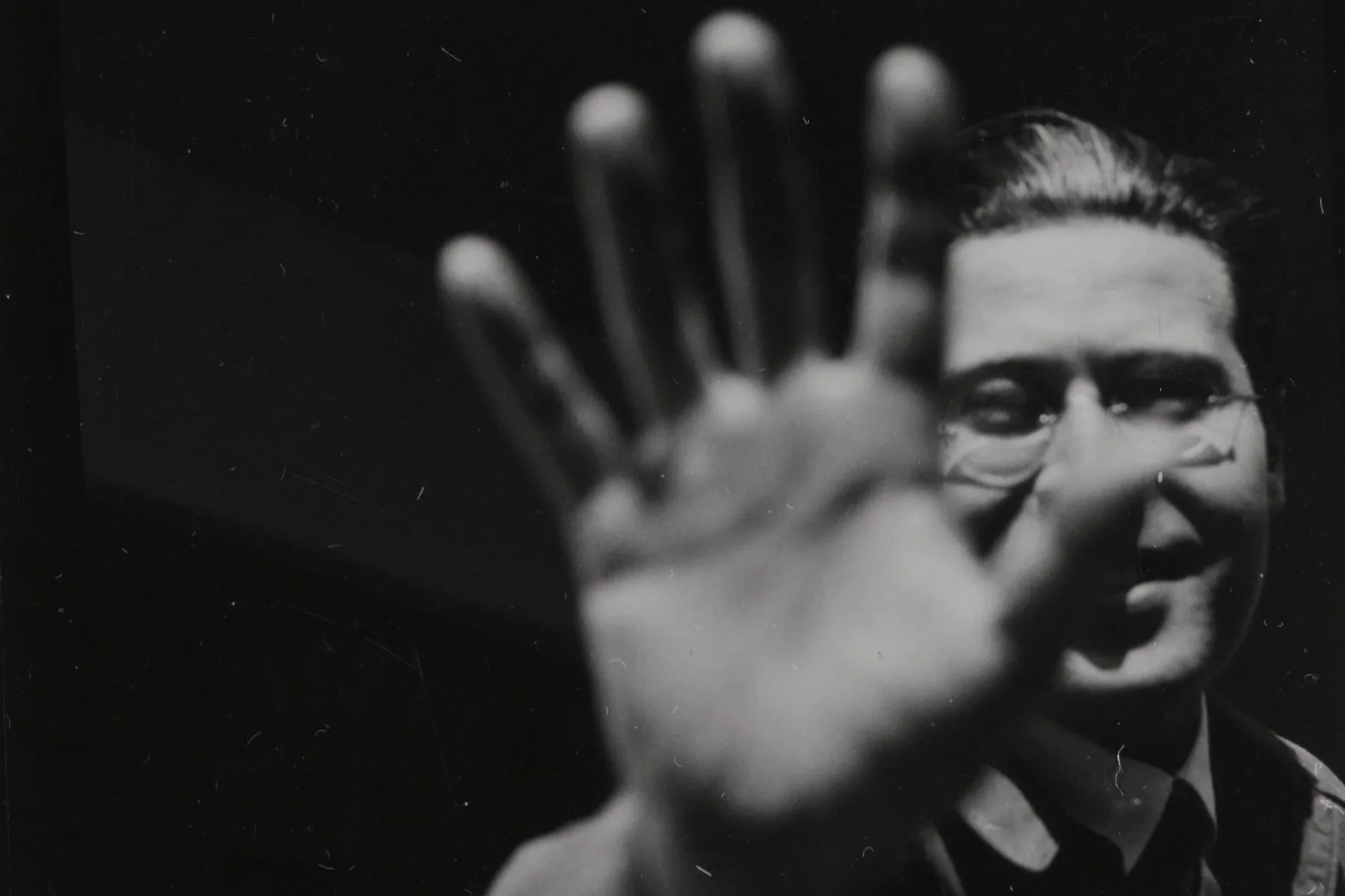
Part of a 2024 series of presentations exploring bleeding-edge artistic ideas and techniques across eras. For The Present Age, I examined László Moholy-Nagy's philosophy and his work integrating scientific tools into art to expand human perception.
This talk narrows to a curious 1942 visit to Texas. Moholy-Nagy, who pioneered the use of photography, film, and light as artistic mediums and was then running Chicago's experimental New Bauhaus, visits a women's college in Denton. The visit sparks the creation of the first studio art program in the Texas public university system and catalyzes early modern art throughout the region.
Pulling from his writing and letters to trace Moholy-Nagy's perspectives on art education and his influence on Texas modernism and women artists, I share personal reflections from viewing his work in Budapest and Los Angeles, then follow the thread to his collaboration with György Kepes at MIT and the founding of the Center for Advanced Visual Studies.
The talk's title references both our current moment and the journal Jelenkor ("The Present Age") that Moholy-Nagy worked with while recovering from war injuries in 1917. I consider how his perception experiments connect to today's expanding visual sensing technologies: drones, telescopes, satellite imaging.
Earlier artistic explorations of human sensing capabilities prefigured our contemporary tools for seeing. The border region where we gather has become a testing ground for the very visual sensing technologies that extend the perceptual experiments Moholy-Nagy began a century ago.
Themes: Expanded perception, art as scientific instrument, transmission of ideas and experimentation, the present as perpetual condition.
Application to future work: Available as a keynote or workshop for foresight teams, R&D groups, and cultural institutions interpreting experimentation. Organizations developing visual sensing technologies or human-computer interfaces are working in territory Moholy-Nagy mapped a century ago. Artists, educators, and institutions asking what expanded perception means now. This talk offers historical grounding for anyone asking how experimental ideas travel, take root, and reshape what comes after.